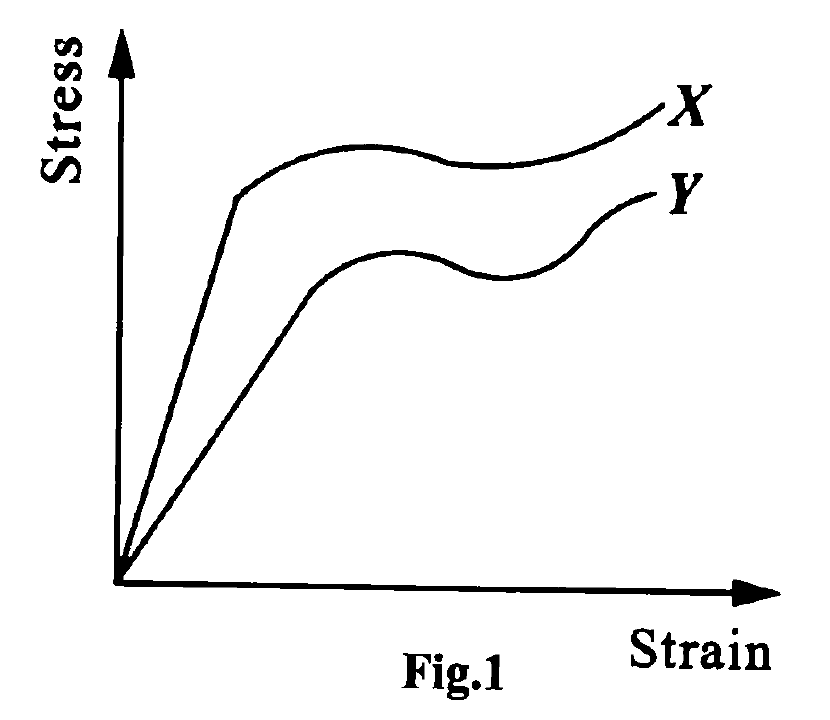
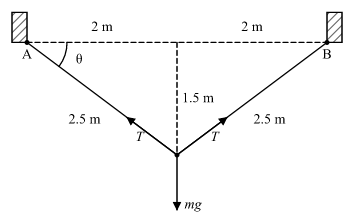
What we are solvingElastic properties of solids: definitions, Hooke's law, a stress-strain graph for metals X and Y,two wires of the same material, a loaded copper wire that sags, and the backward force from a jet of waterChapter: Mechanical properties of matter (elasticity) and fluidsTopic: stress, strain, Young's modulus; momentum of a fluid jet(a)(i)(1 mark)Brittleness is the property of a material by which it breaks (fractures) soon after the elastic limit,with little or no plastic deformation(a)(ii)(1 mark)Elasticity is the property of a material to regain its original size and shapewhen the force deforming it is removed(b)(1 mark)The extension of a material is directly proportional to the applied load (force),provided the proportional limit is not exceeded(c)(i)(2 marks)Young's modulus is the gradient of the straight (elastic) part of the stress-strain graphE=strainstressThe straight part of X is steeper than that of YSo X has the greater Young's modulus(c)(ii)(2 marks)A ductile metal undergoes a large plastic deformation before it breaksX leaves the straight line at a smaller strain than Y, but both break at about the same strainSo X has the longer plastic region (larger plastic strain)X is more ductile(c)(iii)(2 marks)Strength is measured by the breaking (ultimate tensile) stressThe curve of X lies above that of Y and X breaks at a higher stressX is the stronger metal(d)(i)(2 marks)Same material, so the same breaking stress σbFmax=σbA=σbπr2rP=2rQ, so AP=4AQFmax,P=4Fmax,QWire P withstands the greater load (four times that of Q)(d)(ii)(2 marks)Same material, so the same Young's modulus Estrain=AEFFor the same load, strain is inversely proportional to the areaAQ=41AP, so the strain of Q is four times that of PWire Q has the greater strain(e)(4 marks)The wire is 4 m long, fixed between A and B 4 m apart, so it is just taut at firstThe mass hangs at the middle M and pulls it down 1.5 m
New length of each half (Pythagoras)l=22+1.52=6.25=2.5mNew total length =2×2.5=5.0 m, so the extension ise=5.0−4.0=1.0mStrainstrain=Le=4.01.0=0.25Tension in the wire from Young's modulusT=EA×strainA=1.0×10⁻³mm2=1.0×10−3×10−6=1.0×10⁻⁹m2T=1.2×1011×1.0×10−9×0.25=30NEach half makes angle θ with the horizontalsinθ=2.51.5=0.6At M the vertical components of the two tensions hold up the weight2Tsinθ=mg2×30×0.6=m×9.81m=9.8136=3.67kg(f)(3 marks)The water in the tank is at rest; at the hole it leaves with a large velocity vSo the tank gives the water a forward momentum every second: rate of change of momentum =ρAv2By Newton's second law this needs a force on the water by the tank, in the direction of the jetBy Newton's third law the water pushes the tank with an equal force in the opposite directionIn pressure terms: at the hole there is no wall for the water pressure to act on, so the pressure on the opposite wall is unbalancedThe tank is pushed backwards (like the recoil of a gun or a rocket)Answer: (c) X for all three; (d) P carries 4 times the load, Q has 4 times the strain; (e) m≈3.67 kgTip: For a sagging wire, find the new length by Pythagoras first; the extension is new length minus old length