What we are solvingDimensions and a dimensional check of the wave-speed formula
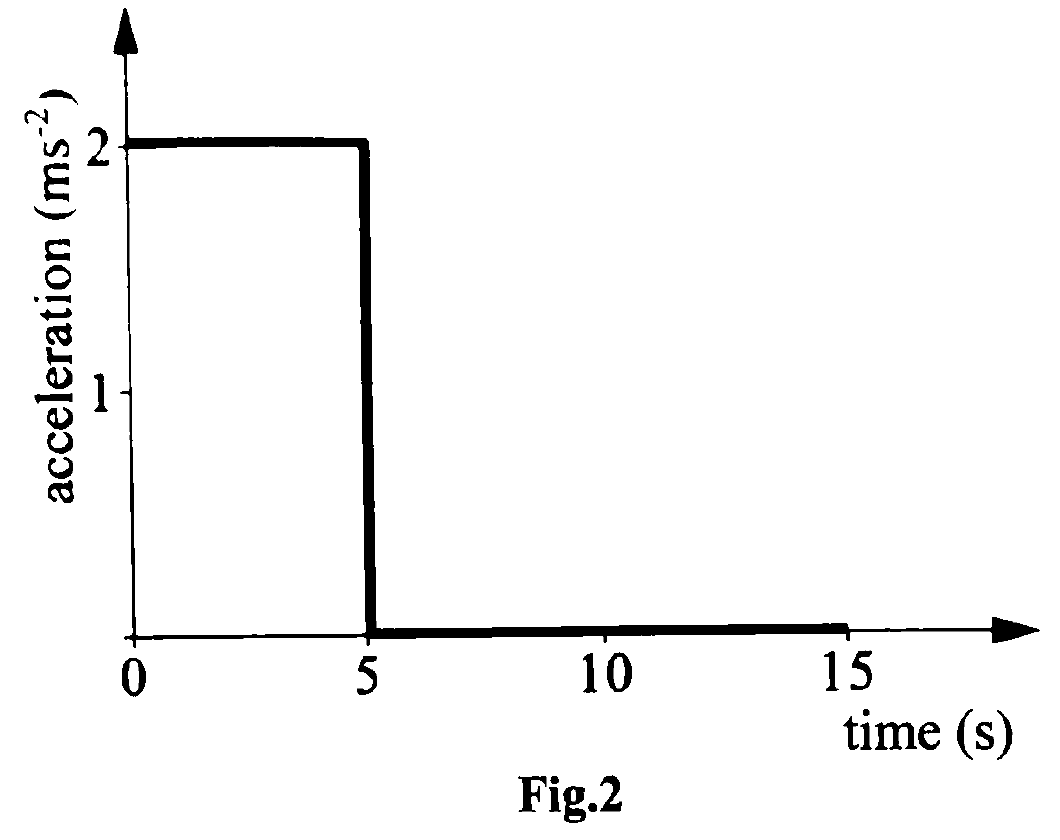
v2=2πλg+λρ2πγDistance and average force from an acceleration-time graph for a 10 kg body starting from rest
Newton's laws, conservation of momentum and an elastic collision result
Chapter: Mechanics
Topic: dimensions; motion graphs; Newton's laws; collisions
(a)(i) (1 mark)The dimensions of a physical quantity are the powers to which the fundamental quantities
mass [M], length [L] and time [T] are raised to express that quantity
(a)(ii) (3 marks)An equation is dimensionally consistent if every term has the same dimensions;
2π has no dimensions
Left side:
[v2]=(LT−1)2=L2T−2First term:
[2πλg]=L×LT−2=L2T−2Surface tension is force per unit length:
[γ]=LMLT−2=MT−2Density:
[ρ]=ML−3Second term:
[λρ2πγ]=L×ML−3MT−2=L2T−2All three terms have dimensions
L2T−2, so the equation is dimensionally consistent
(b)(i) (4 marks)From the graph:
a=2 m s−2 for 0 to 5 s, then
a=0 from 5 s to 15 s
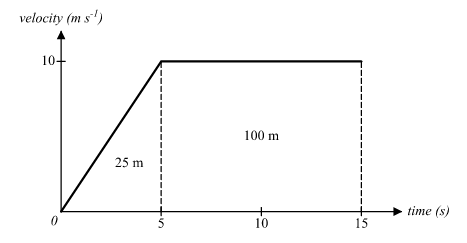
Velocity at 5 s (from rest)
v=u+at=0+2×5=10 m s−1Distance in the first 5 s
s1=ut+21at2=0+21×2×52=25 mFrom 5 s to 15 s the body moves at a steady 10 m/s
s2=10×10=100 mTotal distance (area under the v-t graph)
s=25+100=125 m(b)(ii) (3 marks)Average force = change of momentum / time
F=tm(v−u)F=1510×(10−0)=6.67 N(c) (4 marks)First law: a body continues in its state of rest or of uniform motion in a straight line unless a resultant external force acts on it
Example: when a taxi brakes suddenly, the passengers jerk forward because their bodies tend to keep moving
Third law: to every action there is an equal and opposite reaction (forces act in pairs on different bodies)
Example: a gun recoils backwards when the bullet is fired forwards; when you walk, your foot pushes the ground back and the ground pushes you forward
(Second law, if chosen: the rate of change of momentum is proportional to the resultant force and takes place in its direction,
F=ma; e.g. a harder kick gives a football a greater speed)
(d)(i) (1 mark)In a closed system, where no external force acts, the total linear momentum in any direction remains constant
(d)(ii) (4 marks)Momentum is conserved
M1U1=M1v1+M2v2Divide by
M1 and put
α=M1M2U1−v1=αv2...(1)The collision is elastic, so kinetic energy is also conserved
21M1U12=21M1v12+21M2v22U12−v12=αv22...(2)Divide (2) by (1)
U1−v1(U1−v1)(U1+v1)=αv2αv22 ⇒ U1+v1=v2Put
v2 into (1)
U1−v1=α(U1+v1)U1(1−α)=v1(1+α)U1=v1(1−α)(1+α)Answer: (b)(i) 125 m; (b)(ii) 6.67 N; (d)(ii) shown
Tip: In an a-t graph the area gives the change in velocity; turn it into a v-t graph before finding distance