What we are solvingBernoulli's principle and aircraft lift; the pressure difference and lift for air speeds 135 m/s (top) and 120 m/s (bottom),wing area 28 m², air density 1.2 kg m⁻³; streamline flow and measuring flow speed; speed and mass flow rate of water from a hole in a tankChapter: Fluid mechanics (fluids in motion)Topic: Bernoulli's principle, Venturi meter, Torricelli's theorem(a)(i)(2 marks)For a non-viscous, incompressible fluid in steady (streamline) flow,the sum of the pressure, the kinetic energy per unit volume and the potential energy per unit volume is constant at all pointsP+21ρv2+ρgh=constantSo where the speed of the fluid is high, the pressure is low(a)(ii)(2 marks)
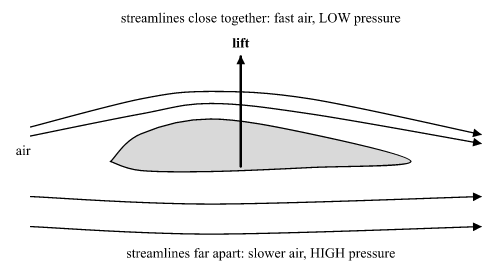
The wing (aerofoil) is curved more on top, so air flows faster over the upper surface than under the lower surfaceBy Bernoulli's principle the pressure above the wing is lower than the pressure below itThe pressure difference acting over the wing area gives a resultant upward force: the lift(b)(i)(2 marks)Bernoulli between the two surfaces (height difference negligible)Pbelow−Pabove=21ρ(v12−v22)v1=135 m/s (top), v2=120 m/s (bottom), ρ=1.2kg m−3ΔP=21×1.2×(1352−1202)ΔP=0.6×(18225−14400)=0.6×3825ΔP=2295Pa(≈2.30×10³Pa)(b)(ii)(2 marks)F=ΔP×AF=2295×28=6.43×10⁴N(c)(i)(2 marks)Streamline flow is steady flow in which every particle passing a given point follows the same path, with the same velocity, as the particles that passed that point before it(the velocity at any point does not change with time and the layers do not cross)(c)(ii)(5 marks)Venturi meter
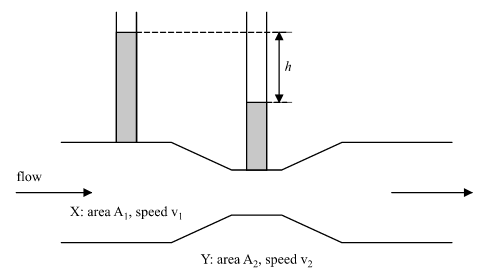
A horizontal tube with a wide section X (area A1) and a narrow throat Y (area A2) is connected into the pipe carrying the fluidVertical tubes (or a manometer) at X and Y show the pressures thereThe fluid flows; the height difference h between the levels is readP1−P2=ρghContinuity: A1v1=A2v2Bernoulli: P1−P2=21ρ(v22−v12)Combining:v1=A2A12−A222ghSo the speed of the fluid in the pipe is found from h and the two areas(d)(i)(3 marks)Depth of the hole below the water surfaceh=2.0−0.10=1.9mThe tank is wide, so the surface is almost at rest; Torricelli's theorem (from Bernoulli)v=2gh=2×9.81×1.9v=37.28=6.11m s−1(d)(ii)(2 marks)dtdm=ρAvA=πr2=π×(2.5×10⁻³)2=1.96×10⁻⁵m2dtdm=1000×1.96×10−5×6.11=0.120kg s−1Answer: (b)(i) 2295 Pa; (b)(ii) 6.43×10⁴ N; (d)(i) 6.11 m/s; (d)(ii) 0.120 kg/sTip: Measure the depth from the water surface to the hole, not to the base of the tank