What we are solvingCircular motion: angular velocity, why uniform circular motion is accelerated, and
a=v2/rProjectile definitions; a ball P thrown up at 36 m/s from the ground and a ball Q dropped 2 s later from 90 m above it: when and where they meet
Chapter: Mechanics (circular motion, motion under gravity)
Topic: centripetal acceleration; vertical motion
(a)(i) (1 mark)Angular velocity is the rate of change of angular displacement (angle swept per second) about the centre
ω=dtdθ(rad s−1)(a)(ii) (3 marks)Velocity is a vector: it has size and direction
On a circle the direction of the velocity (along the tangent) changes all the time, even though the speed is constant
A change of velocity per unit time is an acceleration
This acceleration is directed towards the centre (centripetal) and is produced by a force towards the centre
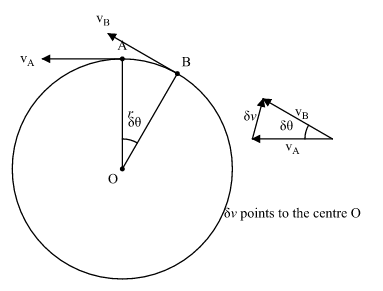
(a)(iii) (4 marks)A body moves from A to B on a circle of radius
r in a short time
δt; the radius turns through
δθThe velocities
vA and
vB have the same size
v and are along the tangents, so the angle between them is also
δθIn the vector triangle the change in velocity is
δv; for small
δθδv=vδθδv points towards the centre O
Acceleration
a=δtδv=vδtδθ=vωWith
v=ωr,
ω=rva=rv2 (=ω2r) towards the centre(b)(i) (1 mark)Projectile motion is the motion of a body which, after being given an initial velocity, moves freely under the action of gravity alone (along a curved path)
(b)(ii) (1 mark)The angle of projection is the angle between the direction of the initial velocity and the horizontal
(c)(i) (7 marks)Take upward as positive, ground as zero height, and time
t from the moment P is thrown;
g=9.81 m s−2Height of P
yP=36t−21(9.81)t2=36t−4.905t2Q starts from rest 90 m up at
t=2 s, so it has fallen for
(t−2) s
yQ=90−4.905(t−2)2They collide when
yP=yQ36t−4.905t2=90−4.905(t2−4t+4)36t−4.905t2=90−4.905t2+19.62t−19.62The
t2 terms cancel
36t−19.62t=70.3816.38t=70.38t=4.30 sCheck: P is still in the air (it lands after
2×36/9.81=7.3 s) and
t is after Q is released
(c)(ii) (3 marks)yP=36(4.297)−4.905(4.297)2yP=154.7−90.6=64.1 mCheck with Q:
90−4.905(2.297)2=90−25.9=64.1 m
Answer: (a)(iii)
a=v2/r; (c)(i) 4.30 s after P is thrown; (c)(ii) 64.1 m above the ground
Tip: Use one clock for both bodies; the late starter's time is
(t−2)