What we are solvingDefinitions of specific heat capacity and specific latent heat; an electrical experiment for latent heat of vaporisation;
specific heat capacity of oil by the continuous flow method (water: 15.2 °C to 17.4 °C, 20 g/min, 2.3 A, 3.3 V; oil: same temperatures, 70.0 g/min, 2.7 A, 3.9 V); effect of pressure on boiling and melting points
Chapter: Heat (calorimetry and change of state)
Topic: specific heat capacity, latent heat, continuous flow method
(a)(i) (1 mark)Specific heat capacity is the quantity of heat needed to raise the temperature of 1 kg of a substance by 1 K (J kg⁻¹ K⁻¹)
(a)(ii) (1 mark)Specific latent heat of vaporisation is the quantity of heat needed to change 1 kg of a liquid at its boiling point into vapour without a change of temperature
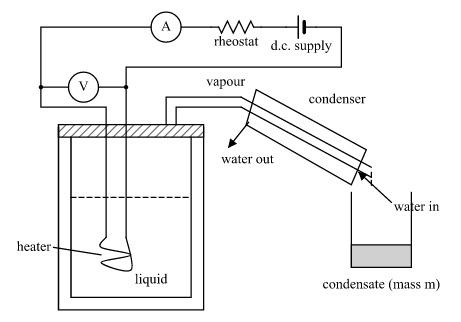
(b) (7 marks)The liquid is put in a lagged (vacuum) flask with an electric heater immersed in it, connected to a d.c. supply, ammeter, rheostat and voltmeter
The vapour passes through a water-cooled condenser and the condensed liquid is collected in a weighed beaker
The heater is switched on and the liquid boiled until a steady state is reached (constant rate of condensation)
The current
I1 and p.d.
V1 are read and the mass
m1 of condensate collected in a time
t is found
The rheostat is changed to a new power
I2V2; when steady again, the mass
m2 collected in the same time
t is found
The heat lost
h is the same in both runs because the temperatures are the same
I1V1t=m1L+hI2V2t=m2L+hSubtracting removes the heat loss
L=m1−m2(I1V1−I2V2)t(c) (5 marks)Continuous flow: electrical power = heat carried away by the liquid + heat lost per second
hIV=tmcΔθ+hBoth liquids flow in and out at the same temperatures, so
Δθ=17.4−15.2=2.2 K and
h is the same
Water: flow rate
=20 g min−1=600.020=3.333×10⁻⁴ kg s−12.3×3.3=3.333×10−4×4200×2.2+h7.59=3.08+h ⇒ h=4.51 WOil: flow rate
=70.0 g min−1=600.070=1.167×10⁻³ kg s−13.9×2.7=1.167×10⁻³×c×2.2+4.5110.53−4.51=2.567×10⁻³cc=2.567×10−36.02=2.35×10³ J kg−1K−1(d)(i) (3 marks)A liquid boils when its saturated vapour pressure equals the external pressure
Raising the external pressure means the liquid must reach a higher s.v.p., which needs a higher temperature
So the boiling point rises with pressure (e.g. a pressure cooker cooks food faster)
Lowering the pressure lowers the boiling point (water boils below 100 °C on high mountains such as Mt Elgon or the Rwenzori)
(d)(ii) (3 marks)Ice contracts when it melts: water at 0 °C is denser than ice
Increasing the pressure favours the denser (liquid) state, so ice melts at a lower temperature
So the melting point of ice is lowered by an increase of pressure (and raised by a decrease)
Example: regelation: a loaded wire passes through a block of ice, the ice melts under the wire and refreezes above it
Answer: (c)
coil≈2.35×10³ J kg−1K−1Tip: Change flow rates from g/min to kg/s before using
IV=tmcΔθ+h