What we are solvingMolar heat capacities and the proof of
CP−CV=R; adiabatic and isothermal changes;
a gas of 400 cm³ at 15 °C expands adiabatically to 0 °C, then is compressed isothermally back to its first pressure (
CP=28.6 J mol−1K−1): final volume; saturated vapour pressure
Chapter: Heat (kinetic theory and thermodynamics of gases)
Topic: molar heat capacities, adiabatic and isothermal processes, vapours
(a)(i) (1 mark)The molar heat capacity at constant pressure is the heat needed to raise the temperature of 1 mole of a gas by 1 K when the pressure is kept constant
(a)(ii) (1 mark)The molar heat capacity at constant volume is the heat needed to raise the temperature of 1 mole of a gas by 1 K when the volume is kept constant
(b) (5 marks)Take 1 mole of an ideal gas; first law:
ΔQ=ΔU+PΔVAt constant volume no work is done, so all the heat raises the internal energy
CVΔT=ΔUAt constant pressure the gas also expands and does work
PΔVCPΔT=ΔU+PΔVFor an ideal gas
U depends only on temperature, so
ΔU is the same for the same
ΔTCPΔT=CVΔT+PΔVFor 1 mole
PV=RT; at constant pressure
PΔV=RΔTCPΔT=CVΔT+RΔTCP−CV=R(c)(i) (2 marks)Adiabatic expansion: no heat enters or leaves the gas (
ΔQ=0); the work is done at the expense of internal energy, so the temperature falls;
PVγ= constant; it is rapid, in an insulated vessel
Isothermal expansion: the temperature stays constant; heat flows in from the surroundings to do the work;
PV= constant; it is slow, in a thin, good-conducting vessel
(c)(ii) (1 mark)Sudden bursting of a bicycle tube or car tyre
Compression and rarefaction of air as a sound wave passes (also the compression stroke of a diesel engine)
(d) (5 marks)T1=15+273=288 K,
V1=400 cm3,
T2=273 K
CV=CP−R=28.6−8.31=20.29 J mol−1K−1γ=CVCP=20.2928.6=1.41Adiabatic stage:
TVγ−1= constant
V2=V1(T2T1)γ−11=400(273288)0.411=455.8 cm3Pressure after it:
PVγ= constant
P1P2=(V2V1)γ=(455.8400)1.41=0.832Isothermal stage at 273 K back to
P1:
P2V2=P1V3V3=P1P2V2=0.832×455.8=379 cm3Check: the first and last states have the same pressure, so
V1V3=T1T3:
400×288273=379 cm3(e)(i) (1 mark)Saturated vapour pressure is the pressure exerted by a vapour which is in dynamic equilibrium with its own liquid (in a closed space) at a given temperature
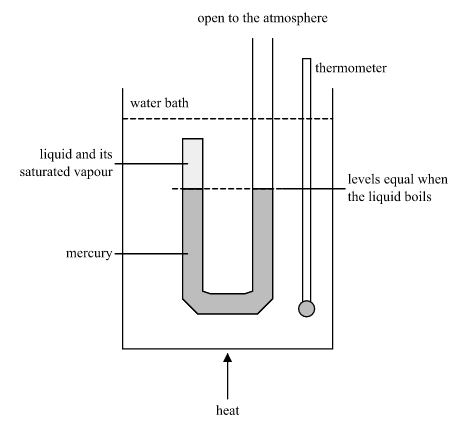
(e)(ii) (4 marks)A little of the liquid is introduced into the closed short limb of a J-tube, above mercury; the long limb is open to the atmosphere
The tube is placed in a water bath with a thermometer and heated slowly while stirring
As the temperature rises the s.v.p. of the trapped vapour rises and pushes the mercury down in the closed limb
When the bath reaches the boiling point of the liquid, the mercury levels in the two limbs are equal
Equal levels mean the vapour pressure in the closed limb equals the atmospheric pressure on the open limb: the liquid boils when its s.v.p. equals atmospheric pressure
Answer: (d) final volume
≈379 cm3Tip: If the start and end pressures are the same,
V/T is the same: a quick check on the long route