What we are solvingTemperature gradient and thermal conductivity; why a poor-conductor specimen is thin and wide; the bolometer;a black sphere at the focus of a concave mirror of diameter 60 cm facing the sun (1400 W m⁻², surroundings 30 °C, sphere reaches 1870 °C): diameter of the sphere; properties of radiant energyChapter: Heat (thermal conduction and radiation)Topic: thermal conductivity, Stefan's law, bolometer(a)(i)(1 mark)Temperature gradient is the rate of change of temperature with distance along the direction of heat flow, dxdθ (K m⁻¹)(a)(ii)(1 mark)Thermal conductivity is the rate of heat flow per unit area per unit temperature gradient, in the steady state, through a material with heat flowing at right angles to its facesk=A(dθ/dx)Q/t(b)(3 marks)tQ=kAxθ1−θ2A poor conductor lets very little heat through, so the rate must be made large enough to measureA thin specimen (small x) gives a large temperature gradient, and a large area A gives a large rate of heat flowBeing thin, the specimen also reaches the steady state quickly and loses very little heat from its sides(c)(6 marks)
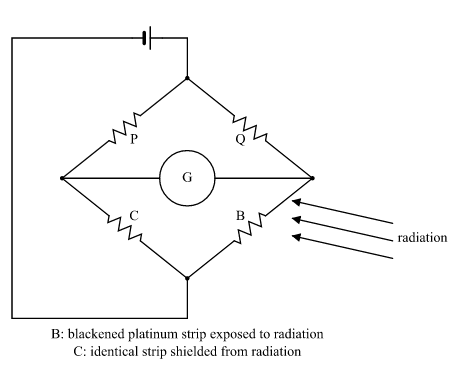
A bolometer B is a thin, blackened platinum strip whose resistance rises with temperature; it forms one arm of a Wheatstone bridgeAn identical strip C, shielded from radiation, is put in the adjacent arm to cancel changes in room temperatureWith no radiation falling on B, the resistances P and Q are adjusted until the galvanometer G reads zero (bridge balanced)Radiation falling on B is absorbed by the black surface, its temperature rises and its resistance increasesThe bridge goes off balance and the galvanometer deflects: this shows radiation is presentThe size of the deflection increases with the intensity of the radiation(d)(6 marks)Power collected by the mirror (area of aperture)Pin=I×πR2=1400×π×0.302=395.8WAt the maximum temperature the sphere loses (net) as much power as it receives; Stefan's law for a black bodyPin=σA(T4−T04),A=4πr2=πd2T=1870+273=2143 K, T0=30+273=303 KT4−T04=2.1091×10¹³−8.43×109=2.1082×10¹³K4πd2=5.67×10−8×2.1082×1013395.8=1.195×106395.8=3.31×10⁻⁴m2d=π3.31×10−4=1.03×10⁻²m≈1.03cm(e)(3 marks)It travels in straight lines and can pass through a vacuumIt travels at the speed of light, 3.0×10⁸m s−1, in a vacuum (it is an electromagnetic wave)It can be reflected and refracted, and it is not deflected by electric or magnetic fields(Also: it obeys the inverse square law; it is absorbed well by dull black surfaces)Answer: (d) diameter of the sphere ≈1.03 cmTip: The mirror collects power over its aperture πR2; the sphere radiates from its whole surface 4πr2