What we are solvingProperties of cathode rays; the parabolic path of an electron in a uniform electric field;
deflection of electrons (
1.0×10⁷ m/s) entering mid-way between plates 5.0 cm long, 4.0 cm apart, p.d. 400 V; specific charge of positive rays and abundance of isotopes
Chapter: Modern physics (electrons and positive rays)
Topic: motion of charges in electric and magnetic fields; mass spectrometer
(a) (2 marks)They travel in straight lines (cast sharp shadows)
They are negatively charged: deflected by electric and magnetic fields (towards the positive plate)
They cause fluorescence in some materials (e.g. zinc sulphide)
They carry energy and momentum: they heat a target and produce X-rays when stopped by a heavy metal target
(Also: they ionise gases and affect a photographic plate)
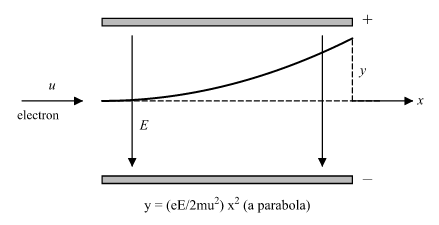
(b) (5 marks)An electron of mass
m and charge
e enters with speed
u along
x, at right angles to a uniform field
E (along
y)
Along
x there is no force, so the speed
u is constant
x=ut ⇒ t=uxAlong
y there is a constant force
eE, so a constant acceleration from zero initial velocity
a=meE,y=21at2=2meEt2Substitute
t=x/uy=(2mu2eE)x22mu2eE is constant, so
y∝x2: the path is a parabola
(c) (4 marks)Field between the plates
E=dV=0.040400=1.0×10⁴ V m−1Acceleration (towards the positive upper plate)
a=meE=1.8×1011×1.0×104=1.8×10¹⁵ m s−2Time to pass the plates
t=ul=1.0×1070.050=5.0×10⁻⁹ sVertical deflection
y=21at2=21×1.8×1015×(5.0×10−9)2=2.25×10⁻² m=2.25 cmKey point: the electron enters mid-way, only 2.0 cm below the upper plate, and 2.25 cm is more than 2.0 cm
So with these data the electron actually strikes the upper plate before the end
21at2=0.020 ⇒ t=4.71×10⁻⁹ s,x=ut=4.71 cmIt hits the upper plate 4.7 cm along (a deflection of 2.0 cm) and does not emerge
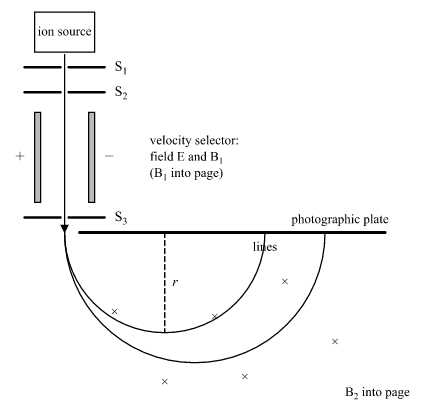
(d)(i) (6 marks)Bainbridge mass spectrographPositive ions from the source pass through slits
S1 and
S2 into a velocity selector: an electric field
E between two plates and a magnetic field
B1 at right angles to it
Only ions for which the electric and magnetic forces balance go straight on through slit
S3eE=B1ev ⇒ v=B1EIn the chamber below, a uniform field
B2 (perpendicular to the page) bends them into a semicircle of radius
r onto a photographic plate
B2ev=rmv2 ⇒ me=B2rvme=B1B2rEr is half the distance from
S3 to the line on the plate;
E,
B1,
B2 are known, so the specific charge is found
(d)(ii) (3 marks)Isotopes have the same charge but different masses; all leave the selector with the same speed
vr=eB2mv, so
r∝m: each isotope makes its own line on the plate
The darkness (intensity) of each line, measured with a densitometer, is proportional to the number of ions of that isotope; the ratio of intensities gives the relative abundance (or an ion collector measures the ion current at each position)
Answer: (c) calculated deflection 2.25 cm; as this exceeds the 2.0 cm half-gap, the electron hits the upper plate 4.7 cm along; (d)(i)
me=B1B2rETip: Always compare a calculated deflection with the space available between the plates