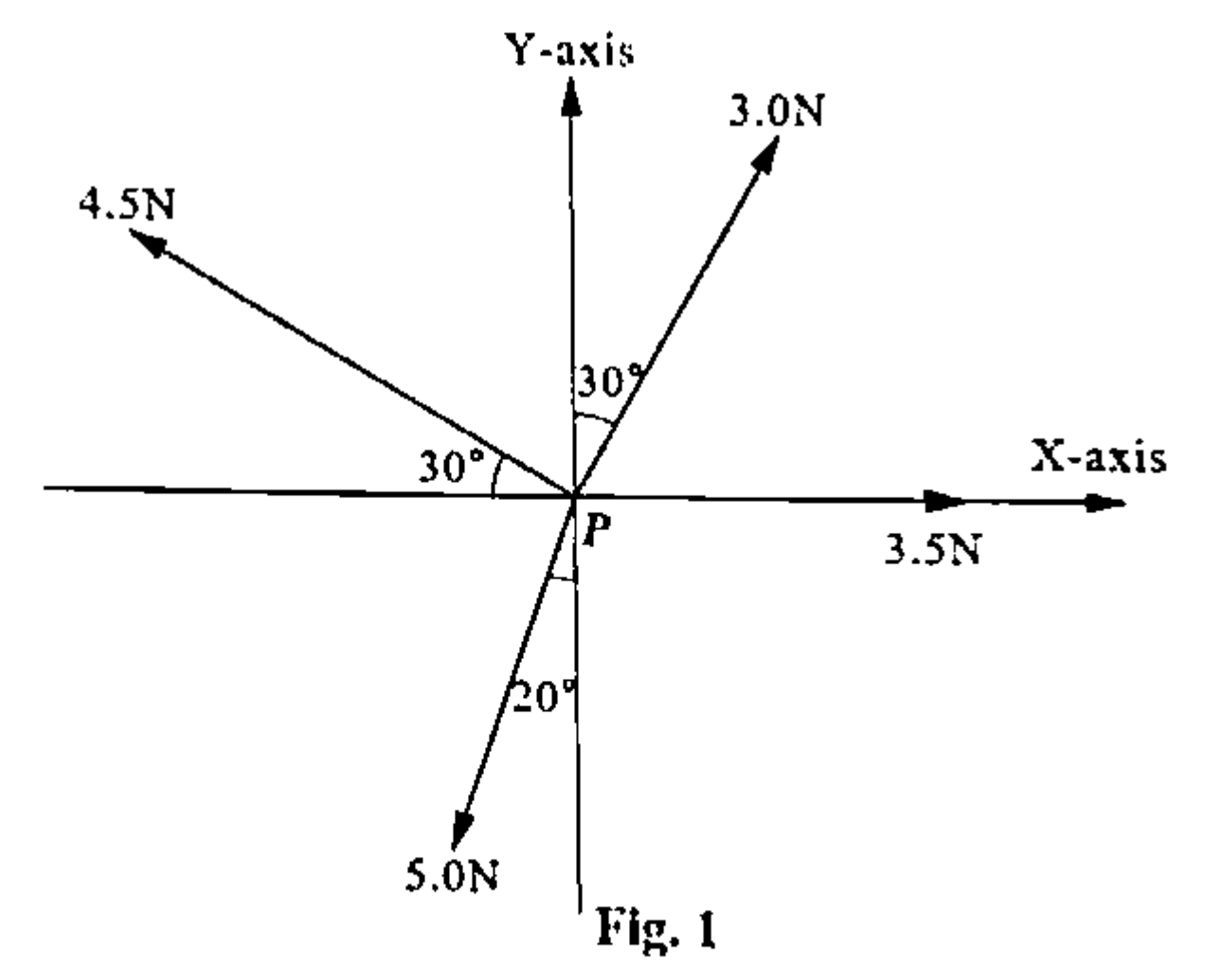
What we are solvingDefinitions: vector and scalar quantities, and the newtonA dimension check that Nkg−1 and ms−2 are the same unitFour forces act on a 0.5kg body P at rest: find how far it moves in 5sLift cable tension going up and going down, and weightlessness in a liftA stone thrown horizontally at 30ms−1 from 60m: find its horizontal rangeChapter: MechanicsTopic: vectors, dimensions, Newton's laws of motion, projectilesConcept and formulasResolve every force into x and y components; the resultant gives the accelerationa=mFR,s=ut+21at2In a lift: T−mg=ma (taking upward acceleration as positive)Horizontal projection: vertical motion is free fall, horizontal speed stays constanth=21gt2,x=utWorking(a)(i)(2 marks)A vector quantity is a physical quantity that has both magnitude and direction, e.g. force, velocity, displacementA scalar quantity is a physical quantity that has magnitude only, e.g. mass, speed, temperature(a)(ii)(1 mark)The newton is the force which gives a mass of 1kg an acceleration of 1ms−2(b)(2 marks)Newton: F=ma, so [N]=MLT−2[Nkg−1]=MMLT−2=LT−2[ms−2]=LT−2Both have dimensions LT−2, so the two units are equivalent(c)(6 marks)Take x to the right and y upwards (Fig. 1)3.0N at 30∘ to the y-axis: 3.0sin30∘=1.50 (x), 3.0cos30∘=2.60 (y)4.5N at 30∘ above the negative x-axis: −4.5cos30∘=−3.90 (x), 4.5sin30∘=2.25 (y)3.5N along the x-axis: 3.50 (x), 0 (y)5.0N at 20∘ to the negative y-axis: −5.0sin20∘=−1.71 (x), −5.0cos20∘=−4.70 (y)Fx=1.50−3.90+3.50−1.71=−0.61NFy=2.60+2.25−4.70=0.15NFR=0.612+0.152=0.625NDirection: tan−1(0.15/0.61)≈14∘ above the negative x-axisAcceleration, with m=500g=0.5kg:a=0.50.625=1.25ms−2P starts from rest (u=0):s=21×1.25×52=15.6m(d)(i)(3 marks)Forces on the lift: cable tension T upwards, weight mg downwardsAscending with upward acceleration a: T−mg=ma, so T=m(g+a), greater than the weightDescending with downward acceleration a: mg−T=ma, so T=m(g−a), less than the weightSo the tension differs because the cable must supply the extra (or smaller) net force needed for the acceleration(When the lift moves at constant velocity, a=0 and T=mg in both directions)(d)(ii)(2 marks)A person feels his weight through the normal reaction R of the floor: R=m(g−a) when the lift accelerates downwardsIf the lift falls freely (for example the cable breaks), a=g, so R=0The floor no longer pushes on the person, so he feels weightless(e)(4 marks)Vertical motion: initial vertical speed is zero60=21×9.81×t2t=9.81120=3.50sHorizontal speed stays 30ms−1:x=30×3.50=105mAnswer: (b) both LT−2; (c) resultant 0.625N, a=1.25ms−2, distance ≈15.6m; (e) ≈105mTip: In a force diagram, write each force's sign before adding components: a wrong sign is the commonest mistake