What we are solvingDefine acceleration and instantaneous velocity
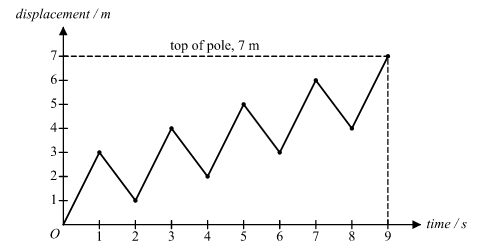
A child climbs
3 m in
1 s, slides back
2 m in the next second, and repeats until the top at
t=9 sDraw the displacement-time graph and find the pole height
State the laws of friction; find the speed of ball A from a collision followed by sliding
Motion of a whirled stone when the string breaks
Chapter: Mechanics
Topic: kinematics, friction, momentum, circular motion
Concept and formulasLinear momentum is conserved in a collision:
mAuA+mBuB=mAvA+mBvBKinetic friction on a horizontal surface:
F=μmg, so the deceleration is
a=μgv2=u2+2asNewton's first law: with no resultant force a body keeps moving in a straight line at constant speed
Working(a)(i) (1 mark)Acceleration is the rate of change of velocity with time (
ms−2)
(a)(ii) (1 mark)Instantaneous velocity is the velocity of a body at a particular instant: the rate of change of displacement at that instant,
v=dtds(b)(i) (4 marks)Positions (m) at each second: 0 s: 0, 1 s: 3, 2 s: 1, 3 s: 4, 4 s: 2, 5 s: 5, 6 s: 3, 7 s: 6, 8 s: 4, 9 s: 7
Each two-second cycle gives a net gain of
3−2=1 mPlot displacement (y-axis) against time (x-axis) and join the points with straight lines (uniform speed in each second):
(b)(ii) (1 mark)After 8 s the child is at
4 m; in the 9th second he climbs
3 m and reaches the top
height=4+3=7 m(c)(i) (3 marks)1. Frictional force opposes the relative motion (or attempted motion) between two surfaces in contact
2. Frictional force is independent of the area of contact of the surfaces
3. Limiting frictional force is directly proportional to the normal reaction between the surfaces
(Also: kinetic friction is nearly independent of the relative speed of the surfaces)
(c)(ii) (5 marks)After the collision, friction decelerates B:
a=μg=0.25×9.81=2.45 ms−2B stops after
81.5 m, so its speed just after the collision is
vB2=2×2.45×81.5 ⇒ vB=20.0 ms−1Momentum before = momentum after (A stops):
5uA+3×15=5×0+3×20.05uA=60−45=15 ⇒ uA=3.0 ms−1Note: the method gives
3.0 ms−1; with these numbers A would be slower than B, so in reality it could not catch B. Use the momentum method shown, as the question intends
(d) (5 marks)While whirling, the tension in the string provides the centripetal force
mv2/r towards the centre
When the string breaks, the centripetal force disappears
By Newton's first law the stone moves off along the tangent to the circle at the point where the string broke
It keeps its speed
v horizontally (it does not fly radially outwards)
At the same time gravity acts on it, so it falls as a projectile: a parabolic path, horizontal speed
v along the tangent, vertical speed increasing at
gAnswer: (b)(ii)
7 m; (c)(ii)
uA=3.0 ms−1; (d) moves along the tangent and falls as a projectile
Tip: For a climb-and-slip problem, list the position at each second before drawing: it avoids miscounting the last climb