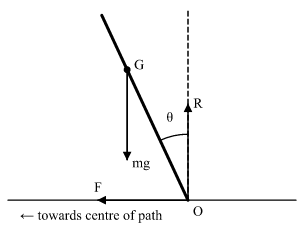
What we are solvingHooke's law and its molecular explanationEvidence that gases are made of moleculesBanked tracks and the speed of a cyclist on a circular pathSpeed and period of a satellite orbiting close to the earthChapter: Mechanics and properties of matterTopic: elasticity, kinetic theory, circular motion, gravitationConcept and formulasCentripetal force needed for circular motion: F=rmv2Newton's law of gravitation: F=r2GMm, and at the surface g=Re2GMPeriod of an orbit: T=v2πrWorking(a)(i)(1 mark)Hooke's law: the extension of a material is directly proportional to the applied load (force), provided the elastic limit (limit of proportionality) is not exceeded(a)(ii)(4 marks)In a solid, molecules sit at an equilibrium separation r0 where the attractive and repulsive forces balance (net force zero)A stretching force increases the separation slightly beyond r0; a net attractive force then appears between the moleculesFor small displacements the force-separation curve near r0 is almost a straight lineSo the restoring force is proportional to the increase in separation, and the total extension of the material is proportional to the loadWhen the load is removed, the molecules return to r0: the material regains its length (elastic behaviour)(b)(4 marks)Brownian motion in a smoke cell:Smoke is put in a small glass cell, lit from the side and viewed through a microscopeBright specks (smoke particles) are seen moving continuously in random zig-zag pathsThe motion is caused by invisible air molecules bombarding each smoke particle unequally from different sidesThis shows that air is made of tiny molecules in constant, random motion (diffusion of gases supports this too)(c)(i)(2 marks)On a banked track, the horizontal component of the normal reaction provides the centripetal forceSo vehicles can go round the bend at higher speed without relying on friction: less skidding, less tyre wear, greater safety(c)(ii)(3 marks)The rider leans inwards at angle θ to the vertical; forces at the ground: normal reaction R (up) and friction F (towards the centre)
Vertical: R=mgHorizontal: friction gives the centripetal force, F=rmv2For no toppling, the resultant of R and F passes through G: tanθ=RF=rgv2v=rgtanθ(The greatest speed without skidding is v=μrg, since F≤μR)(d)(i)(3 marks)Gravity provides the centripetal force; close to the earth the orbit radius is Re:Re2GMm=RemV2⇒V2=ReGMAt the surface, mg=Re2GMm, so GM=gRe2V2=RegRe2=gRe⇒V=(gRe)1/2(d)(ii)(3 marks)T=V2πRe=2πgReRe=6.4×10³km=6.4×10⁶mT=2π9.816.4×106=2π×807.7=5.07×10³sThat is about 84.6 minutesAnswer: (c)(ii) v=rgtanθ; (d)(ii) T≈5.07×10³s (about 85 min)Tip: Change km to m before using g in ms−2