What we are solvingSurface tension, angle of contact and why surface tension falls with temperature
Capillary rise
h in a tube of radius
rWater in pipes: speed in a narrower pipe and pressure
6.0 m higher (Bernoulli)
Terminal velocity of a sphere in a viscous liquid
Chapter: Properties of matter
Topic: surface tension, fluid flow, viscosity
Concept and formulasContinuity equation:
A1v1=A2v2Bernoulli:
P+21ρv2+ρgh=constant along a streamline
Stokes' law: viscous drag
F=6πηrv; upthrust = weight of liquid displaced
Working(a)(i) (2 marks)Surface tension is the force per unit length acting in the surface of a liquid, at right angles to one side of a line drawn in the surface (
Nm−1)
Angle of contact is the angle between the solid surface and the tangent to the liquid surface at the point of contact, measured through the liquid
(a)(ii) (3 marks)As temperature rises, the molecules gain kinetic energy
Their mean separation increases, so the intermolecular attractive forces become weaker
So surface tension decreases as temperature increases, becoming zero at the critical temperature
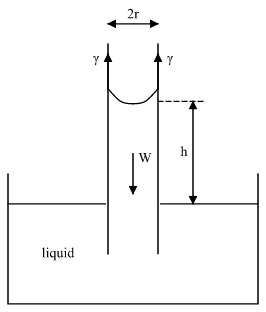
(b) (4 marks)Surface tension acts along the circumference
2πr of the tube; with angle of contact zero it acts vertically upwards
upward force=2πrγWeight of the raised column (meniscus volume neglected):
W=πr2hρgAt equilibrium:
2πrγ=πr2hρgh=rρg2γ(c)(i) (3 marks)Area is proportional to diameter squared:
v2=v1A2A1=v1(d2d1)2=3.0×(1.22.4)2v2=3.0×4=12 ms−1(c)(ii) (4 marks)Take the entry level as
h=0 and the bathroom at
h=6.0 m;
ρ=1000 kgm−3P1+21ρv12=P2+21ρv22+ρghP2=P1+21ρ(v12−v22)−ρghP2=3.6×10⁵+500(9−144)−1000×9.81×6.0P2=3.6×10⁵−67500−58860=2.34×10⁵ Nm−2(d) (4 marks)Forces on the sphere: weight down, upthrust up, viscous drag up
W=34πr3ρg,U=34πr3σg,F=6πηrvAt terminal velocity
v0 the resultant force is zero:
34πr3ρg=34πr3σg+6πηrv06πηrv0=34πr3(ρ−σ)gv0=9η2r2(ρ−σ)gAnswer: (b)
h=rρg2γ; (c)
12 ms−1,
2.34×10⁵ Nm−2; (d)
v0=9η2r2(ρ−σ)gTip: Halving the diameter makes the speed four times larger, not two