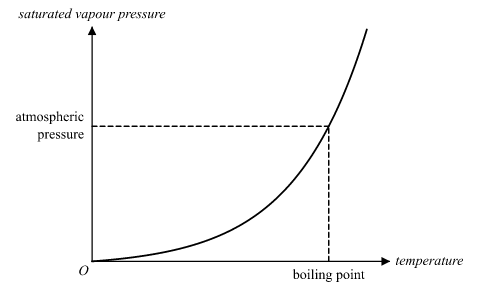
What we are solvingSuperheated water and supercooled vapourHow a gas exerts pressure, and how the atmosphere keeps the earth warmHydrogen: V=0.2m3, M=2gmol−1, P=1.5×10⁴Pa, T=27∘C: number of molecules, mean square speed; r.m.s. speed of oxygen at the same temperatureGraph of saturated vapour pressure against temperatureChapter: HeatTopic: kinetic theory of gases, vapoursConcept and formulasIdeal gas equation: PV=nRT; number of molecules N=nNA (NA=6.02×10²³mol−1)Kinetic theory: P=31ρc2, so c2=ρ3P=M3RT (M in kgmol−1)R=8.31Jmol−1K−1, T=27+273=300KWorking(a)(i)(1 mark)Superheated water is water heated above its boiling point (at that pressure) without boiling(a)(ii)(1 mark)Supercooled vapour is vapour cooled below its condensation point without condensing: its pressure is greater than the saturated vapour pressure at that temperature(b)(i)(3 marks)Gas molecules move randomly at high speeds and collide elastically with the walls of the vesselAt each collision a molecule's momentum changes (by 2mu for a head-on collision), so the wall exerts a force on it and it exerts an equal, opposite force on the wallVery many collisions per second give a steady average force; force per unit area of the wall is the gas pressure(b)(ii)(3 marks)The earth absorbs short-wavelength radiation from the sun and re-radiates long-wavelength infraredCarbon dioxide, water vapour and clouds in the atmosphere absorb much of this infrared and re-radiate part of it back to the earth (greenhouse effect)So less heat escapes to space, especially at night, and the earth does not become unbearably cold(c)(i)(3 marks)n=RTPV=8.31×3001.5×104×0.2=1.20molN=nNA=1.20×6.02×1023=7.24×10²³molecules(c)(ii)(3 marks)M=2gmol−1=2×10⁻³kgmol−1c2=M3RT=2×10−33×8.31×300=3.74×10⁶m2s−2(Same result from ρ=VnM=0.0120kgm−3 and c2=3P/ρ)(c)(iii)(2 marks)At the same temperature, crms∝M1:crms(O2)=MO23RT=32×10−33×8.31×300=483ms−1Check: crms(H2)=3.74×106=1934ms−1, and 1934÷16=483ms−1(d)(4 marks)
The s.v.p. rises with temperature, slowly at first and then more and more steeply (not a straight line)Raising the temperature raises the mean kinetic energy of the liquid molecules, so more molecules have enough energy to escapeThe rate of evaporation rises, so more vapour molecules are needed for dynamic equilibrium: higher vapour pressureThe fraction of molecules with energy above the escape energy grows very rapidly with temperature, so the curve gets steeperWhen the s.v.p. equals the external (atmospheric) pressure, the liquid boilsAnswer: (c)(i) 7.24×10²³ molecules; (c)(ii) 3.74×10⁶m2s−2; (c)(iii) 483ms−1Tip: Always change molar mass to kgmol−1 and temperature to kelvin before using 3RT/M