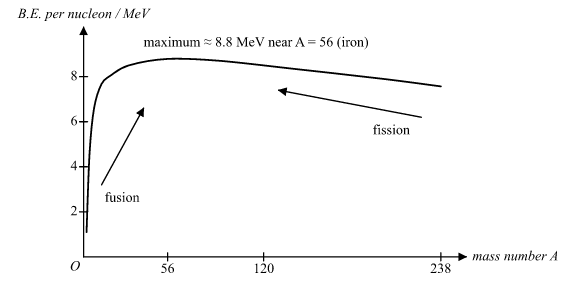
What we are solvingDefine fusion and fission; sketch binding energy per nucleon against mass number and use it to explain where the energy comes from
Photoelectric emission, Einstein's equation and an experiment to find Planck's constant
Show that an electron between charged plates moves on a parabola
Chapter: Modern physics
Topic: nuclear energy, photoelectric effect, motion of electrons in fields
Concept and formulasEnergy is released when nucleons end up more tightly bound (higher binding energy per nucleon)
Einstein:
hf=W0+21mvmax2, and
21mvmax2=eVsUniform field: force on an electron
F=eE, acceleration
a=meEWorking(a)(i) (1 mark)Nuclear fusion is the joining of two light nuclei to form a heavier nucleus, with the release of energy
(a)(ii) (1 mark)Nuclear fission is the splitting of a heavy nucleus into two lighter nuclei of comparable mass (usually after absorbing a neutron), with the release of energy and more neutrons
(b)(i) (1 mark)The curve rises steeply for light nuclei, reaches a maximum of about
8.8 MeV near
A=56 (iron), then falls slowly to about
7.6 MeV for uranium
(b)(ii) (4 marks)Fusion: light nuclei lie on the steep left part of the curve; when two of them combine, the product has a higher binding energy per nucleon
Fission: a heavy nucleus lies on the right, falling part; its fragments have mass numbers nearer the peak and so a higher binding energy per nucleon
In both cases the nucleons become more tightly bound, so the total mass of the products is less than that of the reactants (mass defect)
This mass defect
Δm appears as energy
E=Δmc2: this is the origin of fusion and fission energy
(c)(i) (1 mark)Photoelectric emission is the emission of electrons from a metal surface when electromagnetic radiation of high enough frequency falls on it
(c)(ii) (2 marks)hf=W0+21mvmax2h = Planck's constant,
f = frequency of the radiation,
W0 = work function of the metal (minimum energy to remove an electron),
21mvmax2 = maximum kinetic energy of the emitted electrons
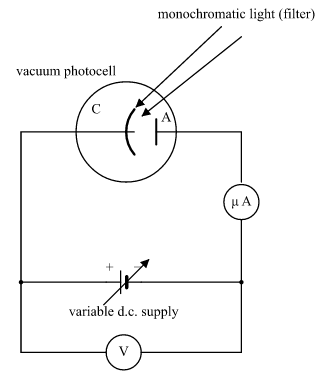
(c)(iii) (7 marks)Set up a vacuum photocell: cathode C (emitter) and anode A, with a microammeter, and a variable supply that makes A negative relative to C; a voltmeter reads the p.d.
Shine monochromatic light of known frequency
f (light through a filter) on the cathode; a photocurrent flows
Increase the reverse p.d. until the microammeter just reads zero; record this stopping potential
VsRepeat with filters of different known frequencies and record
Vs each time
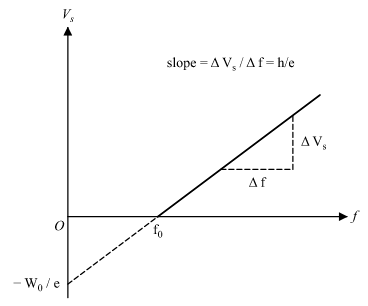
Since
eVs=hf−W0, a graph of
Vs against
f is a straight line:
Vs=ehf−eW0Find the slope
s=ΔfΔVs; then Planck's constant is
h=es (with
e=1.6×10⁻¹⁹ C)
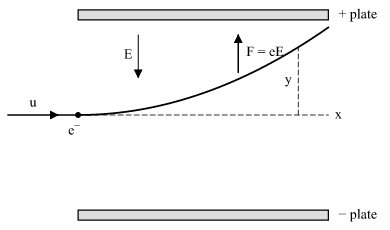
(d) (3 marks)The electron enters midway between the plates with horizontal speed u; the field E between the plates is uniform and vertical
Horizontally there is no force:
x=ut, so
t=uxVertically the force
eE gives constant acceleration
a=meE towards the positive plate, starting from zero vertical speed:
y=21at2y=21⋅meE⋅u2x2=(2mu2eE)x2Since
2mu2eE is constant,
y∝x2: the path is a parabola
Answer: (c)(iii)
h=e× slope of the
Vs against
f graph; (d)
y=2mu2eEx2, a parabola
Tip: The intercept on the frequency axis gives the threshold frequency
f0, and
W0=hf0