What we are solvingReflection at a concave mirror: laws, real and virtual images, the mirror formula, a calculation, the projection lantern and a projector calculation
Given for (c): radius of curvature 30 cm, virtual image three times the object height
Given for (e): slide 5 cm by 5 cm, image 3 m by 3 m, screen 24 m from the lens
Chapter: Reflection of light; optical instruments
Topic: Spherical mirrors; the projection lantern
(a) (2 marks)1. The incident ray, the reflected ray and the normal at the point of incidence all lie in the same plane
2. The angle of incidence is equal to the angle of reflection
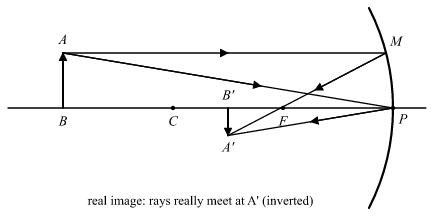
(b)(i) (4 marks)Real image: formed when the object is beyond F (here beyond C)
The reflected rays actually meet at the image, so it can be formed on a screen; it is inverted
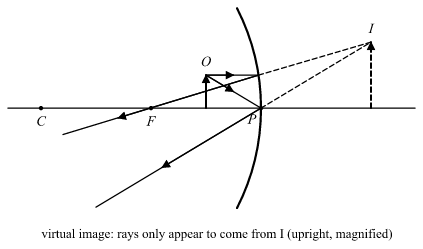
Virtual image: formed when the object is between F and the pole P
The reflected rays diverge and only appear to come from a point behind the mirror, so it cannot be formed on a screen; it is upright and magnified
(b)(ii) (4 marks)Use the real-image diagram: object AB at distance
u, image A'B' at distance
v, focal length
f=PFMirror of small aperture, so M is taken to lie on the line through P and
MP=ABTriangles ABP and A'B'P are similar (the ray AP is reflected at equal angles):
ABA′B′=BPB′P=uv...(1)Triangles MPF and A'B'F are similar:
MPA′B′=ABA′B′=PFB′F=fv−f...(2)Equating (1) and (2):
uv=fv−f ⇒ vf=uv−ufDividing every term by
uvf:
u1=f1−v1 ⇒ u1+v1=f1(c) (3 marks)f=2r=230=15 cm (real-is-positive convention)
Virtual image three times the object height:
v=−3uu1+v1=f1 ⇒ u1−3u1=1513u2=151 ⇒ u=10 cmThe object is 10 cm in front of the mirror (between F and P); the image is 30 cm behind the mirror
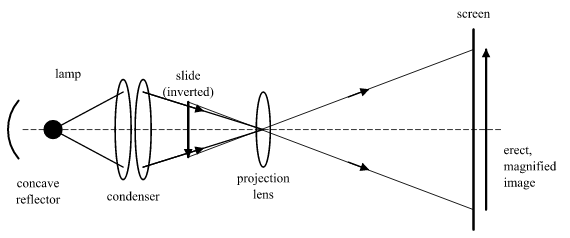
(d) (4 marks)A bright lamp is placed at the centre of curvature of a concave reflector, so light going backwards is reflected forward through the lamp
The condenser (two plano-convex lenses) collects the light and concentrates it on the slide, lighting it evenly and brightly
The slide is placed upside down just outside the focal length of the projection lens
The condenser converges the light into the projection lens, so all the light passing through the slide is used
The projection lens forms a real, magnified image of the slide on the distant screen; since the slide is inverted, the image is erect
Focusing is done by moving the projection lens towards or away from the slide
(e) (3 marks)Magnification:
m=object sizeimage size=0.05 m3 m=60m=uv with
v=24 m, so
u=6024=0.40 m
f1=u1+v1=0.401+241=2.5+0.0417=2.5417 m−1f=0.393 m (≈39.3 cm)Check:
f=m+1v=6124=0.393 m
Answer: (c) object 10 cm in front of the mirror; (e) f ≈ 0.393 m (39.3 cm)
Tip: For a magnified virtual image in a concave mirror the object is always between F and P: here 10 cm < 15 cm, as expected