What we are solvingRefraction: the laws, refractive index, the result n sin i = constant, a ray through water, glass and liquid A to a silvered side, real and apparent depth, and an object in a pool seen from different positions
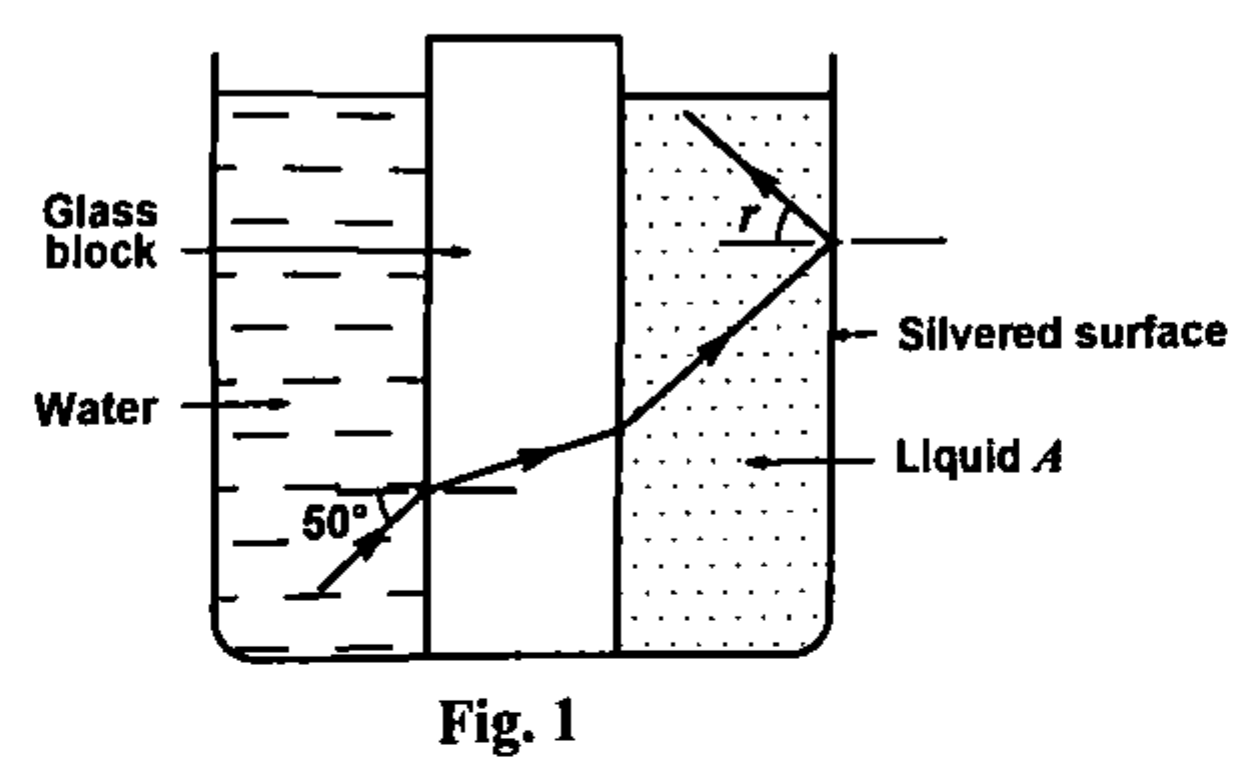
Given for (c): angle of incidence in water 50°, refractive indices water 1.33, glass 1.50, liquid A 1.25
Chapter: Refraction of light
Topic: Laws of refraction; refraction at plane surfaces; real and apparent depth
(a)(i) (2 marks)1. The incident ray, the refracted ray and the normal at the point of incidence all lie in the same plane
2. For a given pair of media, the ratio
sinrsini is a constant (Snell's law)
(a)(ii) (1 mark)Refractive index of a medium is the ratio of the sine of the angle of incidence in a vacuum (air) to the sine of the angle of refraction in the medium
Equivalently
n=vc=speed of light in the mediumspeed of light in vacuum(b) (4 marks)Let a ray cross media 1, 2, 3, ... (absolute refractive indices
n1,n2,n3) separated by parallel plane boundaries, making angles
i1,i2,i3 with the normal in each medium
The refractive index from medium 1 to medium 2 is the ratio of the speeds:
1n2=v2v1=c/v1c/v2=n1n2Snell's law at the first boundary:
sini2sini1=1n2=n1n2 ⇒ n1sini1=n2sini2In the same way at the second boundary:
n2sini2=n3sini3So for every medium the ray passes through:
n1sini1=n2sini2=n3sini3=nsini=constant(c) (5 marks)All the boundaries and the silvered side are vertical, so they share the same (horizontal) normal; use
nsini= constant
nwsin50∘=ngsinθg=nAsinθA1.33×sin50∘=1.33×0.7660=1.0188In glass:
sinθg=1.501.0188=0.6792 ⇒ θg=42.8∘In liquid A:
sinθA=1.251.0188=0.8151 ⇒ θA=54.6∘The ray meets the silvered side at an angle of incidence
54.6∘ to the normal
By the laws of reflection the angle of reflection equals the angle of incidence, and
r is the angle between the reflected ray and the normal (Figure 1):
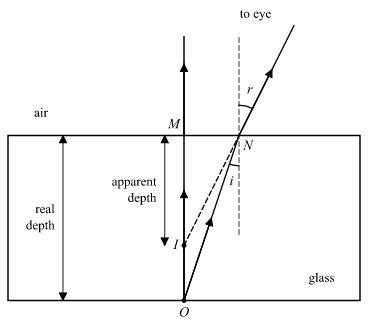
r=54.6∘(d) (4 marks)O is an object at the bottom of the block; the ray OM along the normal passes straight out
The ray ON makes angle
i with the normal in glass and is refracted away from the normal at angle
r in air
To the eye the refracted ray seems to come from I, the image of O
Refraction from glass to air:
ng=sinisinrFrom the triangles:
sini=ONMN and
sinr=INMNng=MN/ONMN/IN=INONFor an eye directly above, N is very close to M, so
ON≈OM and
IN≈IM:
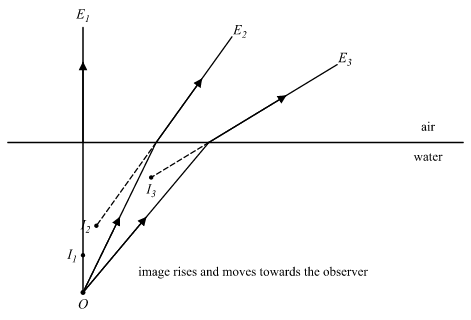
ng=IMOM=Apparent depthReal depth(e) (4 marks)Viewed vertically (E
1), the object O appears raised to I
1 at the apparent depth (about 3/4 of the real depth for water)
As the observer moves to oblique positions (E
2, E
3), the rays leave the surface at larger angles and are bent more away from the normal
The image therefore appears shallower than before (it rises, I
2 then I
3) and also moves sideways towards the observer
At very oblique (grazing) viewing the image appears to lie almost at the surface of the water
Answer: (c) r ≈ 54.6°; (d) n = real depth / apparent depth; (e) the image rises and moves towards the observer as the view becomes more oblique
Tip: In (c) the glass block does not change the final angle: only the water and liquid A values matter