What we are solvingStationary waves and the speed of sound, an application of the Doppler effect, and the echo heard by a passenger in a train
Given for (c): train speed 25 m s⁻¹, frequency of its sound 980 Hz
The speed of sound is not given; we take
v=330 m s⁻¹
Chapter: Waves; sound
Topic: Stationary waves; the Doppler effect
(a)(i) (4 marks)A stationary wave is formed when two progressive waves of the same frequency, the same amplitude and the same speed travel along the same line in opposite directions and superpose
This usually happens when a wave is reflected and meets the incident wave
At some points the two waves always arrive in antiphase and cancel: these are nodes (zero amplitude)
Midway between nodes the waves arrive in phase and reinforce: these are antinodes (maximum amplitude)
Adjacent nodes are
2λ apart and no energy is carried along the wave
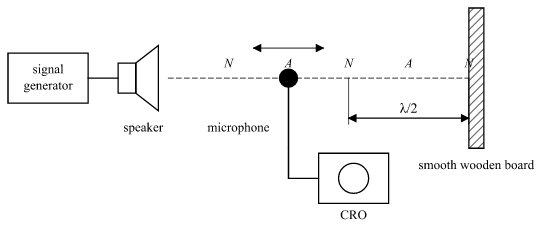
(a)(ii) (5 marks)Connect the speaker to a signal generator set at a known frequency
f and point it at a smooth wooden board placed some distance away
The sound reflected by the board meets the incident sound and a stationary wave is set up between the speaker and the board
Connect the microphone to a CRO and move it slowly along the line from the board towards the speaker
The trace on the CRO rises to a maximum at antinodes and falls to a minimum at nodes
Measure the distance
d between two successive minima (or
nd over several nodes):
d=2λv=fλ=2fdRepeat for other frequencies and take the mean value of
v(b) (3 marks)Radar speed check (police speed trap):
Microwaves of known frequency
f are sent towards a moving vehicle and reflected back to the detector
Because the vehicle is moving, the reflected waves have a changed (Doppler-shifted) frequency
f′The shift
Δf=f′−f≈c2uf is measured, giving the speed
u=2fcΔf of the vehicle
(c)(i) (4 marks)Let
v = speed of sound,
u = speed of the train,
f = frequency of the train's sound
Step 1: the train (source) moves towards the wall; the waves ahead are squeezed:
λ′=fv−uThe wall is at rest, so it receives
f1=λ′v=v−uvfStep 2: the wall reflects sound of frequency
f1 as a stationary source; the waves travel at
v with wavelength
v/f1The passenger moves towards the wall at
u, so the waves pass him at relative speed
v+u:
f2=v/f1v+u=vv+uf1f2=(v−uv+u)f(c)(ii) (4 marks)Once the train has passed the wall it moves away from it, so the signs of
u change in both steps
Wall receives
f1′=v+uvf; the passenger, moving away, receives
f2′=vv−uf1′f2′=(v+uv−u)f=330+25330−25×980=355305×980f2′≈842 HzFor comparison, while approaching the wall the echo is
305355×980≈1141 Hz; the pitch drops from about 1141 Hz to about 842 Hz as the train passes the wall
Answer: (a)(ii) v = 2fd; (c)(i) f' = f(v + u)/(v − u); (c)(ii) about 842 Hz after passing the wall (1141 Hz while approaching), with v = 330 m s⁻¹
Tip: A moving source changes the wavelength; a moving observer changes the relative speed of the waves