What we are solvingInterference of light: coherent sources, the two ways of getting them, the air wedge and the diameter of a wire, and the test for flatness
Given for (c): slides 10.0 cm long, 20 dark fringes in 5.0 mm, wavelength 500 nm
Chapter: Wave nature of light
Topic: Interference; air wedge; thin films
(a) (3 marks)1. They have the same frequency (same wavelength)
2. They have a constant phase difference (they are in phase or keep a fixed phase difference)
3. They have equal or nearly equal amplitudes (and are close together)
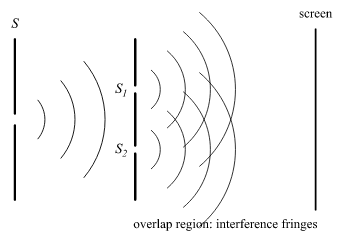
(b)(i) (2 marks)Light from one narrow slit S spreads out as a wavefront that falls on two narrow slits S
1 and S
2The two slits take two parts of the same wavefront, so they act as coherent sources; their waves overlap and give fringes (Young's double slit)
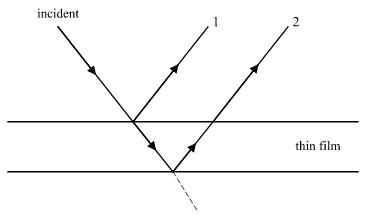
(b)(ii) (2 marks)A ray falling on a thin film is partly reflected at the top surface (ray 1) and partly transmitted, then reflected at the bottom surface (ray 2)
The amplitude of the one beam is divided between rays 1 and 2, which are coherent and interfere (thin films, air wedge, Newton's rings)
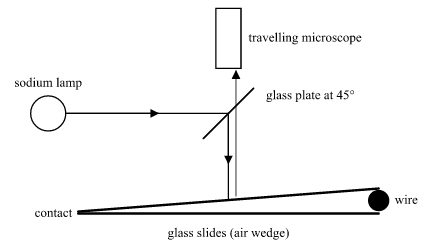
(c)(i) (5 marks)Light from the sodium lamp is turned vertically down onto the wedge by the glass plate at 45°
Part of the light is reflected at the lower surface of the upper slide, and part at the upper surface of the lower slide
Where the air film has thickness
t, the second ray travels an extra distance
2tReflection at the lower slide (air to glass) adds a phase change of
π (half a wavelength)
Dark fringes appear where
2t=mλ and bright fringes where
2t=(m+21)λ; the line of contact (
t=0) is dark
Since
t is constant along lines parallel to the line of contact, the fringes are straight, parallel and equally spaced
(c)(ii) (3 marks)Fringe separation:
s=205.0 mm=0.25 mm=2.5×10⁻⁴ m
Going from one dark fringe to the next, the thickness increases by
2λ, so the wedge angle is
tanθ=2sλAlso
tanθ=Ld, where
d = diameter of the wire,
L = length of the slides
d=2sLλ=2×2.5×10−40.100×500×10−9d=1.0×10⁻⁴ m=0.10 mm(d)(i) (2 marks)Constructive interference: two waves meet in phase (path difference
mλ), so the resultant amplitude is a maximum: a bright fringe
Destructive interference: two waves meet in antiphase (path difference
(m+21)λ), so the resultant amplitude is a minimum: a dark fringe
(d)(ii) (3 marks)Place an optically flat glass plate on the surface under test, slightly tilted, so that a thin air wedge forms between them (arrangement as in the figure above)
Illuminate it normally with monochromatic light and view the fringes through a travelling microscope
If the surface is flat, the fringes are straight, parallel and equally spaced
If the fringes are curved or irregular, the surface is not flat
Answer: (c)(ii) diameter of the wire = 1.0 × 10⁻⁴ m (0.10 mm)
Tip: In an air wedge each fringe means a change of λ/2 in the thickness of the air film