What we are solvingMagnetic fields and forces: field lines, the catapult field, F = BIl from energy, the field of a straight wire, the neutral point of two wires, and the moving coil galvanometer
Given for (c)(ii): currents 3 A (wire A) and 5 A (wire B) in opposite directions, 0.2 m apart
Chapter: Magnetic effects of an electric current
Topic: Force on a conductor; fields of currents; moving coil instruments
(a)(i) (1 mark)A magnetic field line is a line drawn in a magnetic field such that the tangent to it at any point gives the direction of the magnetic field at that point (the path a free north pole would take)
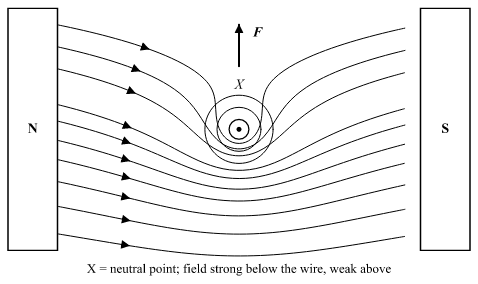
(a)(ii) (4 marks)The wire's own circular field (anticlockwise for current out of the paper) combines with the uniform field from N to S
Below the wire the two fields are in the same direction: the field is strong and the lines are crowded
Above the wire they are opposite: the field is weak and there is a neutral point X
The field lines behave like stretched elastic strings, so the wire is pushed from the strong field towards the weak field: it moves upwards (catapult field)
(b) (4 marks)Let the conductor move a small distance
Δx at right angles to the field while the current
I is kept constant
Area swept out:
lΔx; flux cut:
ΔΦ=BlΔxAn e.m.f.
E=ΔtΔΦ is induced, opposing the current; the source does work against it
Electrical energy supplied:
W=EIΔt=IΔΦ=BIlΔxBy conservation of energy this equals the mechanical work done by the force:
FΔxFΔx=BIlΔx ⇒ F=BIl(c)(i) (1 mark)B=2πaμ0Iμ0 = permeability of free space,
I = current,
a = perpendicular distance from the conductor
(c)(ii) (3 marks)With opposite currents, the two fields are in the same direction between the wires, so they cannot cancel there
They cancel outside the wires, on the side of the smaller current (wire A)
Let the point be
x from A, so
(x+0.2) from B:
2πxμ0×3=2π(x+0.2)μ0×53(x+0.2)=5x ⇒ 2x=0.6 ⇒ x=0.3 mThe flux density is zero 0.3 m from wire A, on the side away from B (0.5 m from B)
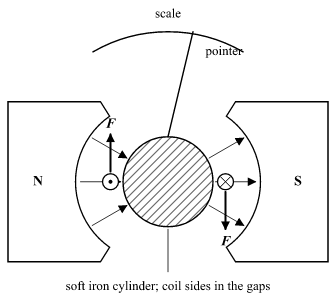
(d)(i) (5 marks)A rectangular coil of fine insulated wire is wound on a light aluminium frame and pivoted between the concave poles of a strong permanent magnet
A soft iron cylinder inside the coil makes the field radial, so the plane of the coil is always parallel to the field
When current
I flows, the coil sides experience equal and opposite forces forming a couple of moment
BANI (A = area, N = turns)
The coil turns, winding up the hair springs, until the restoring couple
cθ balances the deflecting couple:
BANI=cθSo
θ=cBANI: the deflection is proportional to the current and the scale is uniform; the pointer moves over the scale
The aluminium frame provides eddy current damping so the pointer settles quickly
(d)(ii) (2 marks)Make it ballistic: give the coil a large moment of inertia (heavy coil) and a weak suspension, so its period is long and all the charge passes before the coil moves appreciably
Reduce damping to a minimum by winding the coil on a non-conducting former; the first throw is then proportional to the charge
Answer: (c)(i) B = μ₀I/(2πa); (c)(ii) 0.3 m from A, on the side away from B
Tip: Opposite currents: the null point lies outside, nearer the smaller current; like currents: between the wires