What we are solvingElectromagnetic induction: the laws, the induced charge, the ballistic galvanometer, a mutual induction calculation and finding the earth's horizontal field
Given for (c): 500 turns per metre, area 6.0 cm², secondary 2000 turns, total resistance 10 Ω, sensitivity 4.0 divisions per μC, current 5.0 A switched off
Chapter: Electromagnetic induction
Topic: Laws of induction; induced charge; ballistic galvanometer; earth's magnetic field
(a)(i) (2 marks)Faraday's law: whenever the magnetic flux linking a circuit changes, an e.m.f. is induced, and its magnitude is directly proportional to the rate of change of flux linkage
Lenz's law: the induced current flows in a direction such as to oppose the change that produces it
(a)(ii) (4 marks)Induced e.m.f. in a coil of
N turns:
E=−NdtdϕInduced current:
I=RE=−RNdtdϕCharge that flows while the flux changes from
ϕ1 to
ϕ2:
Q=∫Idt=−RN∫ϕ1ϕ2dϕ=−RN(ϕ2−ϕ1)Q=RN(ϕ1−ϕ2)The charge depends only on the change in flux, not on how fast it changes
(b) (4 marks)1. The coil has a large moment of inertia (heavy coil): its period of oscillation is long, so the whole pulse of charge passes before the coil starts to move appreciably; the coil receives an impulse
2. Damping is very small: the coil is wound on a non-conducting former (no eddy currents) and is suspended in air, so the energy given by the impulse is not lost and the first throw is proportional to the charge passed
(c) (4 marks)Flux density inside the long coil:
B=μ0nI=4π×10−7×500×5.0=3.14×10⁻³ TFlux through each turn of the secondary:
ϕ=BA=3.14×10−3×6.0×10−4=1.885×10⁻⁶ Wb
Switching off reduces the flux to zero, so the charge through the galvanometer is
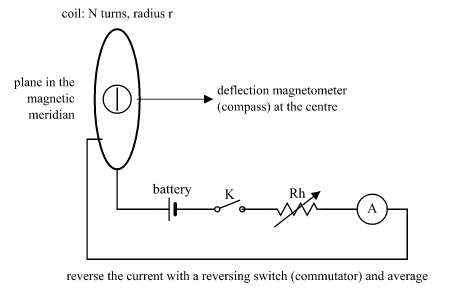
Q=RNϕ=102000×1.885×10−6=3.77×10⁻⁴ C=377 μCdeflection=4.0×377≈1.51×10³ divisions(d) (6 marks)Place a plane circular coil of N turns and radius r vertically in the magnetic meridian, with the deflection magnetometer (compass) at its centre
With no current, turn the magnetometer so the pointer reads 0–0 (needle in the plane of the coil)
Connect the coil in series with a battery, key K, rheostat Rh and ammeter A
Pass a current I and read the deflection
θ1; reverse the current and read
θ2; take the mean
θThe needle rests where the coil's field
B=2rμ0NI (east–west) and the earth's horizontal component
BH give a resultant along it:
B=BHtanθRepeat for several values of I and plot
tanθ against I: a straight line through the origin of gradient
s2rμ0NI=BHtanθ ⇒ BH=2rsμ0NAnswer: (a)(ii) Q = N(φ₁ − φ₂)/R; (c) Q = 377 μC, deflection ≈ 1.51 × 10³ divisions; (d) B_H = μ₀N/(2rs)
Tip: In a ballistic galvanometer problem, find the charge first, then multiply by the charge sensitivity