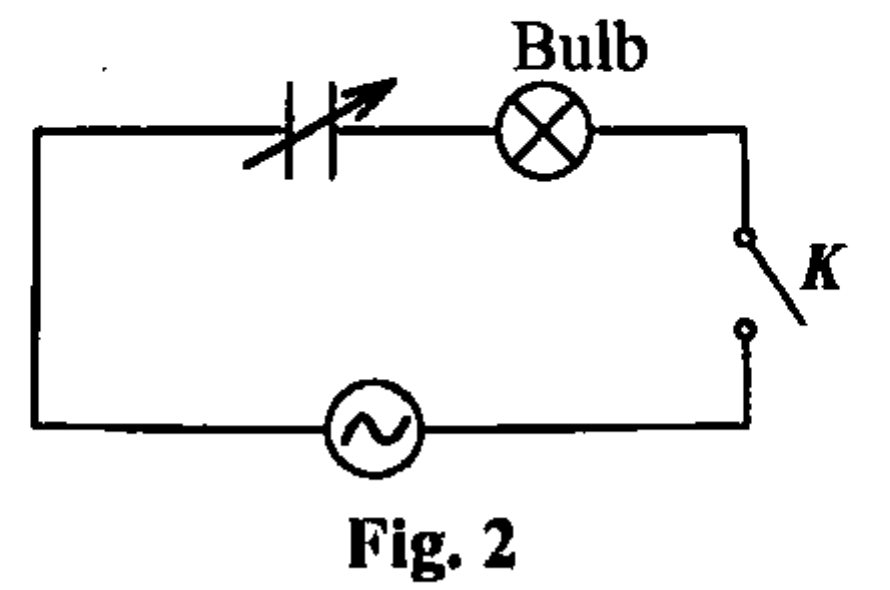
What we are solvingAlternating current: reactance and frequency, the r.m.s. value, an inductor calculation, a capacitor and bulb circuit, and the hot wire ammeterGiven for (c): peak p.d. 20 V, frequency 50 Hz, inductance 0.5 HChapter: Alternating currentsTopic: R.m.s. values; reactance of inductors and capacitors; a.c. meters(a)(i)(1 mark)Reactance is the opposition of an inductor or a capacitor to the flow of alternating current, X=IrmsVrms, measured in ohms (no power is used up in it)(a)(ii)(1 mark)Frequency is the number of complete cycles made by the alternating current (or voltage) in one second(b)(4 marks)The r.m.s. value is the steady (d.c.) current that produces heat at the same rate in a resistor as the alternating currentInstantaneous power: P=I2R=I02Rsin2ωtUsing sin2ωt=21(1−cos2ωt), and the mean of cos2ωt over a cycle is zero:⟨sin2ωt⟩=21⇒⟨P⟩=2I02REqual heating: Irms2R=2I02RIrms=2I0≈0.707I0(c)(3 marks)Reactance: XL=2πfL=2π×50×0.5=157.1ΩR.m.s. p.d.: Vrms=220=14.14 VIrms=XLVrms=157.114.14=0.090A(d)(i)(2 marks)The bulb lightsThe a.c. source charges and discharges the capacitor alternately in opposite directions, so an alternating current flows in the circuit through the bulb (a capacitor passes a.c.)(d)(ii)(2 marks)Reactance XC=2πfC1 falls when C increasesThe current increases, so the bulb glows more brightly(d)(iii)(2 marks)XC=2πfC1 rises when the frequency fallsThe current decreases, so the bulb becomes dimmer(e)(5 marks)
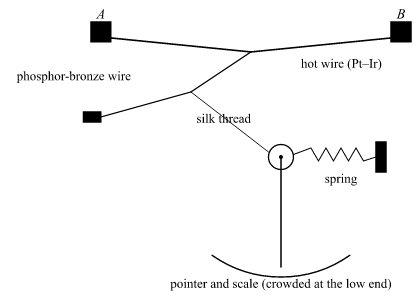
A fine platinum–iridium wire AB is stretched between two terminals; a phosphor-bronze wire is attached to its midpoint and to a fixed pointA silk thread from this wire passes round a pulley on the pointer axle and is kept taut by a springThe current to be measured flows through AB and heats it (I2R); the wire expands and sagsThe spring takes up the slack, turning the pulley and the pointer over the scaleThe heating is proportional to I2 whatever the direction of the current, so the meter reads r.m.s. values of a.c. (and d.c.); it is calibrated with d.c., and its scale is non-uniform (crowded at the low end)Answer: (b) I_rms = I₀/√2; (c) I_rms ≈ 0.090 A; (d) bulb lights, brighter when C increases, dimmer when f decreasesTip: Inductor: X_L rises with f; capacitor: X_C falls with f and with C