What we are solvingElectrostatics and capacitors: Coulomb's law, the charge at D that makes the force on A zero, capacitance by a vibrating reed switch, energy density, and dielectrics
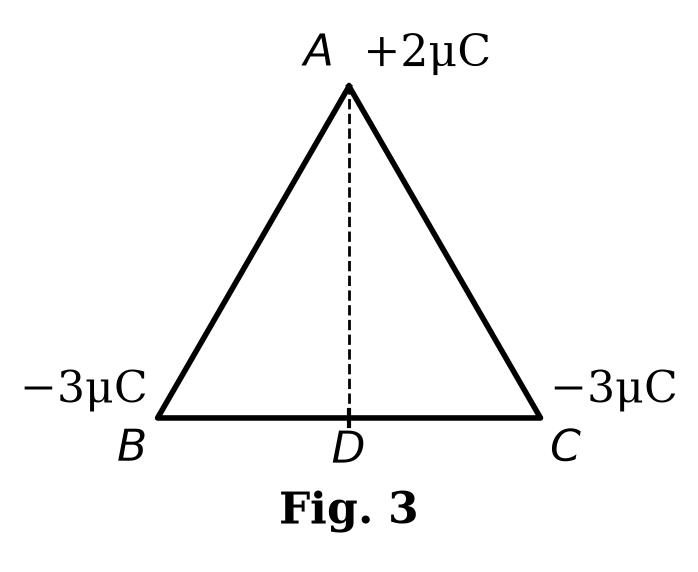
Given for (a)(ii): +2 μC at A, −3 μC at B and C, equilateral triangle of side 4.0 cm, D the mid-point of BC
Given for (b)(ii): 50 charges per second, 25 V supply, average current 10 μA
Chapter: Electrostatics; capacitors
Topic: Coulomb's law; capacitance; energy stored; dielectrics
(a)(i) (1 mark)The force between two point charges is directly proportional to the product of the charges and inversely proportional to the square of the distance between them:
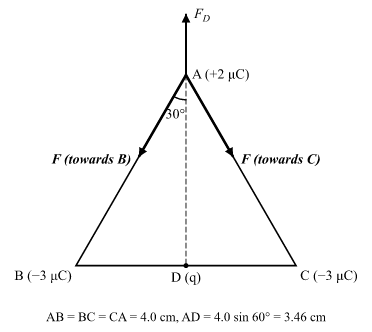
F=4πε0r2Q1Q2(a)(ii) (5 marks)A is attracted towards B and towards C by forces of equal size:
F=4πε01r2QAQB=(0.040)29.0×109×2×10−6×3×10−6=33.75 NEach force makes 30° with AD; the components along BC cancel, the components along AD add (towards D):
R=2Fcos30∘=2×33.75×0.866=58.5 NThe charge
q at D must push A away from D with 58.5 N, so
q must be positive
AD=4.0sin60∘=3.46 cm, so
AD2=1.2×10⁻³ m²
1.2×10−39.0×109×2×10−6×q=58.5q=9.0×109×2×10−658.5×1.2×10−3=3.9×10⁻⁶ CA charge of about
+3.9 μC must be placed at D
(b)(i) (1 mark)Capacitance is the ratio of the charge on either plate of a capacitor to the potential difference between the plates,
C=VQ (unit: farad)
(b)(ii) (3 marks)Each time it is charged the capacitor takes
Q=CV; it is discharged through the galvanometer
n times per second
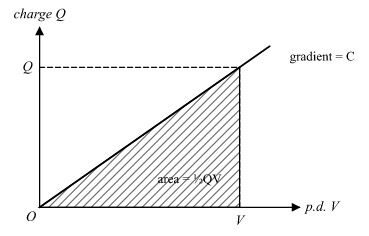
I=nQ=nCVC=nVI=50×2510×10−6=8.0×10⁻⁹ F (8.0 nF)(c)(i) (1 mark)Q is directly proportional to V: a straight line through the origin with gradient C
(c)(ii) (4 marks)The work done in charging the capacitor is the area under the Q–V graph:
W=21QV=21CV2For a parallel plate capacitor:
C=dε0A and
V=EdW=21⋅dε0A⋅E2d2=21ε0E2(Ad)The field fills the volume
Ad between the plates, so the energy per unit volume is
AdW=21ε0E2(d)(i) (1 mark)A dielectric is an insulating material (e.g. mica, paper, wax) whose molecules become polarised in an electric field but which has no free charges to conduct
(d)(ii) (4 marks)In the field between the plates the dielectric molecules are polarised
Negative induced charges appear on the dielectric face next to the positive plate, positive induced charges next to the negative plate
These induced charges set up a field opposite to the applied field, so the resultant field between the plates is reduced
With the same charge Q, the p.d.
V=Ed falls, so the capacitance
C=VQ increases
Answer: (a)(ii) +3.9 μC at D; (b)(ii) C = 8.0 × 10⁻⁹ F; (c)(ii) energy per unit volume = ½ε₀E²
Tip: Use symmetry: only the force components along the axis of symmetry AD survive