What we are solvingElectrostatics: conductors and insulators, corona discharge, induced charges on an earthed rod near a charged sphere, potential graphs, E and V, and a charged smoke particle
Given for (d)(ii): plates 12 mm apart, upper plate at +1800 V, lower plate earthed, particle mass 4.8 × 10⁻¹⁵ kg
Chapter: Electrostatics
Topic: Charging by induction; distribution of charge; electric potential and field
(a)(i) (3 marks)Charge a gold leaf electroscope so that the leaf diverges
Holding the material in the hand, touch the cap of the electroscope with it
If the leaf collapses quickly, the charge has flowed through the material and the body to earth: the material is a conductor
If the divergence does not change, no charge flows: the material is an insulator
(a)(ii) (3 marks)At a sharp point of a charged conductor the surface charge density is very high, so the electric field near the point is very strong
This field ionises the air molecules near the point
Ions of opposite sign are attracted to the point and neutralise its charge, while ions of the same sign are repelled (electric wind); the conductor loses its charge: this is corona discharge (action at points)
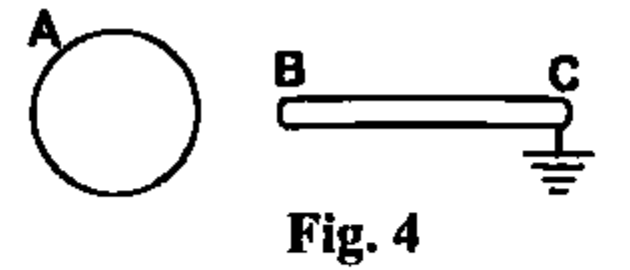
(b) (4 marks)The positive charge on A induces negative charge on the near end B of the rod and positive charge on the far end
Since the rod is earthed at C, the induced positive charge flows to earth (electrons flow up from earth), leaving the rod with a net negative charge
This negative charge near A produces a negative potential at A
So the potential of A falls (it decreases), and the capacitance of A increases
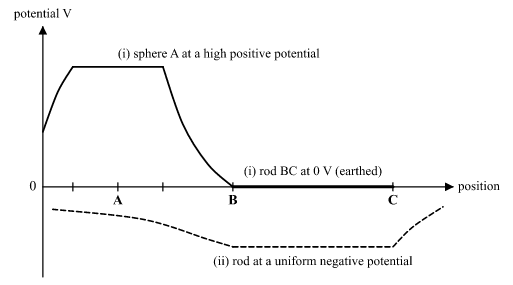
(c)(i) (2 marks)A has a constant high positive potential over its surface and inside it
The potential falls through the air gap from A to B and is zero along the whole earthed rod BC
(c)(ii) (2 marks)When the earth connection is broken and then A is removed, the rod keeps its net negative charge
The rod is a conductor, so the charge spreads over it and the whole rod is at the same negative potential; the potential rises towards zero away from the rod (dashed graph)
(d)(i) (3 marks)Let a small test charge
q be moved a small distance
Δx against a field of intensity E
Work done against the field:
ΔW=−qEΔxBy definition of potential difference,
ΔW=qΔVqΔV=−qEΔx ⇒ E=−dxdVThe field intensity equals the negative potential gradient
(d)(ii) (3 marks)E=dV=12×10−31800=1.5×10⁵ V m−1Held stationary: electric force upwards balances the weight
qE=mg ⇒ q=Emg=1.5×1054.8×10−15×9.81=3.14×10⁻¹⁹ CThe upper plate is positive, so the field points downwards; an upward force needs a negative charge
Charge of the particle
≈−3.14×10⁻¹⁹ C (about 2 electron charges)
Answer: (b) the potential of A decreases; (d)(i) E = −dV/dx; (d)(ii) q ≈ 3.14 × 10⁻¹⁹ C, negative
Tip: An earthed conductor is always at zero potential, whatever charges are near it