What we are solvingCurrent electricity: e.m.f., drift velocity, why a potentiometer may not give a two-way deflection, a potentiometer with a coil Q in series, and measuring an e.m.f.
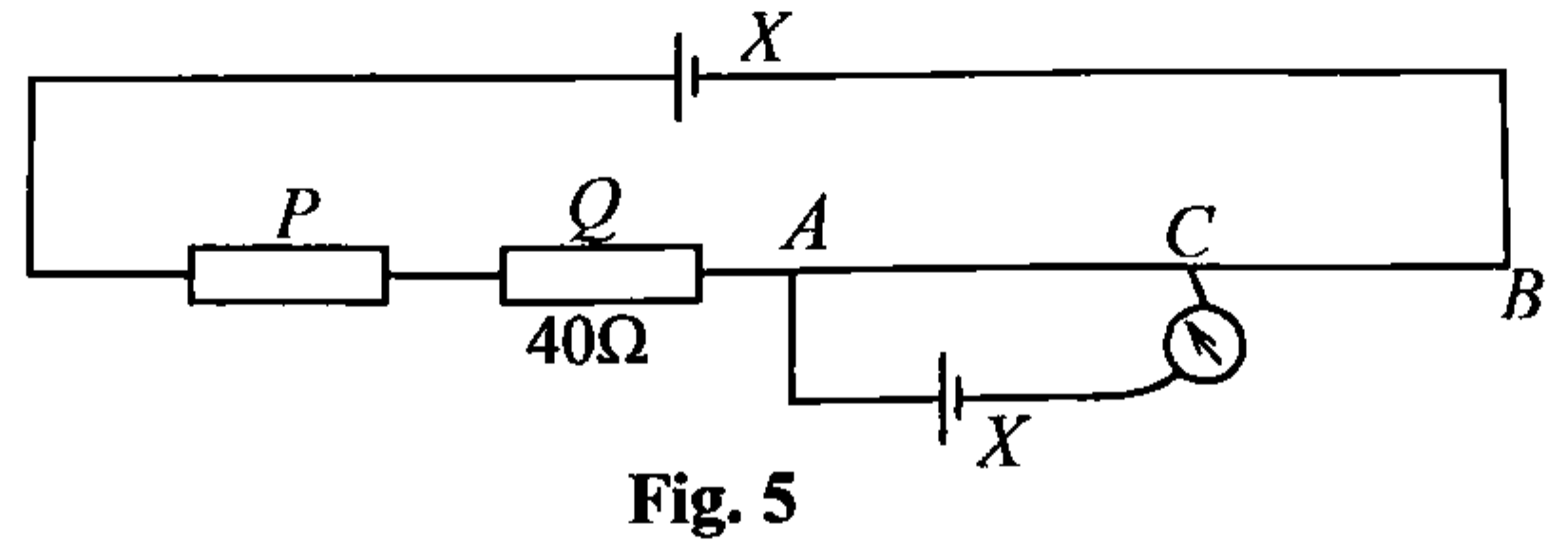
Given for (d): wire 1.0 m long, resistance 4.0 Ω; Q = 40 Ω; drop across Q plus 32.0 cm balances 1.018 V; 68.5 cm balances the cell under test X
In Figure 5 the accumulator at the top drives the current through P, Q and the wire (the driver accumulator); the cell X in the lower loop with the galvanometer is the cell under test
Chapter: Current electricity
Topic: E.m.f.; drift velocity; the potentiometer
(a) (1 mark)The e.m.f. of a cell is the energy converted from other forms (chemical) into electrical energy per coulomb of charge driven round a complete circuit; it equals the p.d. across its terminals on open circuit
(b) (4 marks)Consider a length
l of the conductor; the carriers move along it with drift velocity
vNumber of carriers in this length:
n×(volume)=nAlTotal charge:
Q=nAleTime for all of them to pass a cross-section:
t=vlI=tQ=l/vnAle=nAvev=nAeI(c) (4 marks)1. The e.m.f. of the driver cell is less than the e.m.f. of the cell being measured, so the p.d. across the whole wire cannot balance it
2. The positive terminals of the driver cell and of the test cell are not joined to the same end of the wire
3. The resistance in series with the driver cell (rheostat) is too large, so the p.d. across the wire is too small
4. There is a break or loose connection in the driver circuit (or the driver cell is run down)
(d) (6 marks)Let
I be the steady current from the driver accumulator through P, Q and the slide wire
Resistance per cm of wire:
100 cm4.0 Ω=0.040 Ω cm−1Resistance of 32.0 cm:
32.0×0.040=1.28 ΩFirst balance (Q plus 32.0 cm against 1.018 V):
I(40+1.28)=1.018 ⇒ I=41.281.018=2.466×10⁻² AResistance of 68.5 cm:
68.5×0.040=2.74 ΩSecond balance (68.5 cm against the cell under test X), with the same current since P is unchanged:
EX=I×2.74=2.466×10−2×2.74=6.76×10⁻² VThe e.m.f. of the cell under test X is about 0.068 V (67.6 mV)
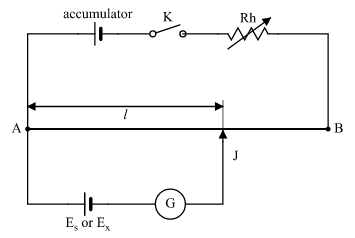
(e) (5 marks)Connect the driver accumulator, key K and rheostat Rh across the potentiometer wire AB
Connect a standard cell of known e.m.f.
Es with its positive terminal to A (the same end as the driver's positive) through a galvanometer G to the jockey J
Close K and slide the jockey along the wire to find the point where G shows no deflection; measure the balance length
lsReplace the standard cell by the cell under test and find its balance length
lx, keeping the rheostat unchanged
The p.d. across the wire is proportional to length, so
EsEx=lslx ⇒ Ex=lslxEsAt balance no current flows through the test cell, so the full e.m.f. (not the terminal p.d.) is measured
Answer: (b) v = I/(nAe); (d) e.m.f. of the cell under test ≈ 6.76 × 10⁻² V; (e) E_x = (l_x/l_s)E_s
Tip: In (d) Q is part of the driver circuit, so its p.d. adds to that of the 32.0 cm of wire at the first balance