What we are solvingAvogadro's constant, specific charge and Thomson's e/m experimentMillikan's oil drop: free fall at 2.5×10⁻⁴m s−1; held still by 2387V across plates 1.5cm apartNumber of charges on the drop, and its speed after gaining two more electronsMeasuring an a.c. voltage with a C.R.O.Chapter: Modern physicsTopic: Electrons (e/m, Millikan, C.R.O.)(a)(i)(1 mark)Avogadro's constant is the number of particles (atoms or molecules) in one mole of a substance, 6.02×10²³mol−1(a)(ii)(1 mark)Specific charge is the charge per unit mass of a particle, e/m (unit C kg−1)(b)(6 marks)
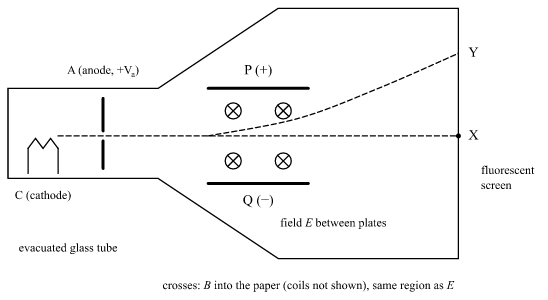
Electrons from the hot cathode C are accelerated by the p.d. Va to the anode A; a narrow beam passes through itWith no fields the beam hits the fluorescent screen at XAn electric field E=V/d between plates P and Q deflects the beam to YA magnetic field B, perpendicular to both the beam and E, is applied over the same region and adjusted until the spot returns to XThen the forces balance: eE=Bev⇒v=BEThe kinetic energy comes from the accelerating p.d.: 21mv2=eVame=2Vav2=2VaB2E2(c)(i)(5 marks)With no p.d. the drop falls at terminal speed: weight = viscous drag (upthrust of air neglected)34πa3ρg=6πηav0⇒a2=2ρg9ηv0a2=2×900×9.819×1.8×10−5×2.5×10−4=2.29×10⁻¹²⇒a=1.51×10⁻⁶mmg=34πa3ρg=34π(1.51×10⁻⁶)3×900×9.81=1.28×10⁻¹³NWhen stationary, the electric force balances the weightE=dV=0.0152387=1.59×10⁵V m−1q=Emg=1.59×1051.28×10−13=8.07×10⁻¹⁹Cn=eq=1.6×10−198.07×10−19=5.04≈5The upper plate is positive and the force is upward, so the drop carries 5 negative (electronic) charges(c)(ii)(4 marks)The charge becomes 7e: upward electric force 7eE, weight mg=5eENet upward force=7eE−5eE=2eEThe drop rises at a terminal speed v where drag balances this net force6πηav=2eEand6πηav0=5eEv0v=52⇒v=0.4×2.5×10−4=1.0×10⁻⁴m s−1upwards(d)(3 marks)Connect the a.c. voltage to the Y-plates (Y-input); with the time base off a vertical line appearsMeasure the length l of the line (peak-to-peak) on the screen grid and note the Y-gain (volts per cm)Peak voltage V0=21l×Y-gain; r.m.s. voltage Vrms=2V0Answer: (c)(i) 5 electronic charges; (c)(ii) 1.0×10⁻⁴m s−1 upwardsTip: Use the ratio of forces in (c)(ii): drag is proportional to speed, so the speed scales with the net force