What we are solvingReflection at plane and curved mirrors: definitions, a proof, two experiments and a calculation
Given for (c)(ii): radius of curvature 48 cm, real image three times the object size
Chapter: Reflection of light
Topic: Plane and spherical (concave) mirrors
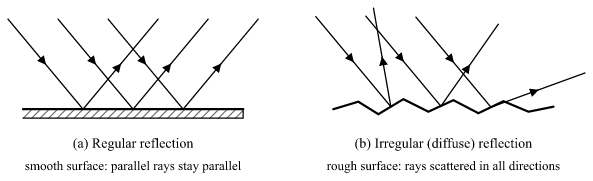
(a)(i) (3 marks)Regular reflection: happens at a smooth, polished surface (e.g. a plane mirror)
A parallel beam of incident rays is reflected as a parallel beam in one direction, so a clear image is formed
Irregular (diffuse) reflection: happens at a rough surface (e.g. paper, a wall)
Each ray obeys the laws of reflection, but the normals at the tiny surfaces point in different directions
So a parallel beam is scattered in all directions and no image is formed
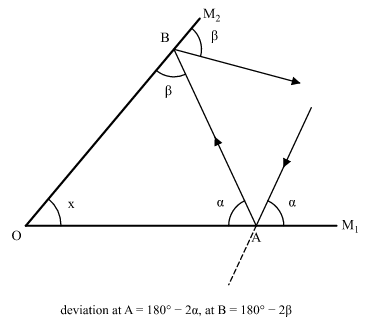
(a)(ii) (3 marks)Let mirrors
M1 and
M2 meet at O at angle
xA ray strikes
M1 at A with glancing angle
α, then strikes
M2 at B with glancing angle
βDeviation at one reflection with glancing angle
θ is
180∘−2θd1=180∘−2α,d2=180∘−2βBoth deviations are in the same sense, so the total deviation is
D=d1+d2=360∘−2(α+β)In triangle OAB the angles are
x,
α and
β:
α+β=180∘−xD=360∘−2(180∘−x)=2xSo the total deviation is
2x, whatever the angle of incidence
(b) (4 marks)Arrangement: an object pin O is placed in front of the concave mirror, nearer than its focus, so the mirror forms a virtual image behind it
A plane mirror is placed upright between the pin and the concave mirror, covering only the lower half of the concave mirror
Looking into both mirrors, the plane mirror is moved until its image of the pin coincides with the image in the concave mirror (no parallax)
Measure:
u = distance from pin to concave mirror,
x = distance from pin to plane mirror
The plane-mirror image is
x behind the plane mirror, i.e.
2x from the pin, so the concave-mirror image is at a distance
v=2x−u (behind the concave mirror, virtual)With the real-is-positive convention
v is negative:
f1=u1−2x−u1Repeat for other values of
u and take the mean value of
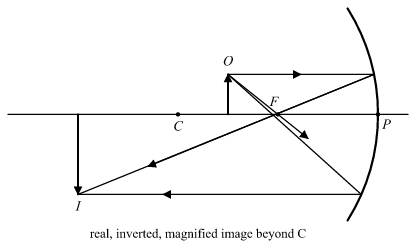
f(c)(i) (2 marks)Object placed between F and C: the image is real, inverted, magnified and beyond C
(c)(ii) (2 marks)f=2r=248=24 cmReal image three times the object:
v=3uu1+v1=f1u1+3u1=2413u4=241 ⇒ u=32 cmThe object is 32 cm in front of the mirror (image at 96 cm)
(d) (4 marks)Place the empty concave mirror on a bench, facing up, with a pin clamped horizontally above it
Move the pin up or down until it coincides with its own inverted image (no parallax); the pin is then at the centre of curvature
Measure the height
R of the pin above the pole of the mirror
Pour a little of the liquid into the mirror and repeat; the rays are refracted at the liquid surface, so the new position of no parallax is lower
Measure the new height
h of the pin above the liquid surface
Refractive index of the liquid:
n=apparent depthreal depth=hR(e) (2 marks)When a wide parallel beam falls on a concave mirror of large aperture, the rays far from the axis cross the axis nearer the mirror than the rays near the axis (spherical aberration)
The reflected rays touch a bright curved surface (envelope) with its cusp at the principal focus; this bright curve is the caustic curve
Answer: (a)(ii) D = 2x; (c)(ii) object 32 cm from the mirror; (d) n = R/h
Tip: In (c)(ii) a real image means v = +3u in the real-is-positive convention