What we are solvingVisual angle, the Galilean telescope, the erecting-lens telescope and a calculation on an astronomical telescope
Given for (d): objective diameter 20 cm,
fo=200 cm,
fe=2 cm, normal adjustment
Chapter: Optical instruments
Topic: Visual angle and telescopes
(a)(i) (1 mark)Visual angle is the angle which an object subtends at the eye
(a)(ii) (3 marks)All the poles have the same height, but the nearer pole is closer to the eye
So the nearer pole subtends a larger visual angle at the eye
A larger visual angle forms a larger image on the retina
The brain judges size by the size of the retinal image, so the nearer pole appears taller
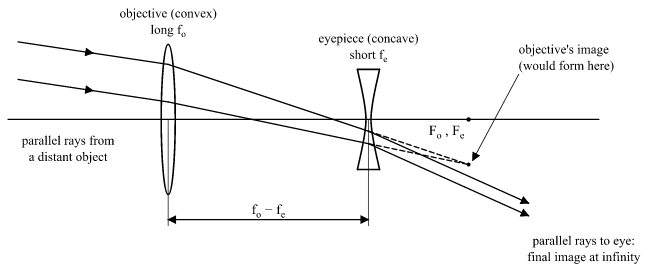
(b)(i) (5 marks)The Galilean telescope has a convex objective of long focal length
fo and a concave eyepiece of short focal length
feParallel rays from a distant object are converged by the objective towards its focal plane
Before they form this image, the rays meet the concave eyepiece
The eyepiece is moved until its focal point coincides with the focal point
Fo of the objective
Rays converging towards the focal point of a concave lens emerge parallel, so the final image is at infinity
In this normal adjustment the separation of the lenses is
fo−fe, and the final image is erect
M=fefo(b)(ii) (2 marks)Advantages: the final image is erect; the tube is short (
fo−fe)
Limitations: the field of view is very small, because the eye-ring is virtual (between the lenses) and the eye cannot be placed there
(c)(i) (2 marks)Put a convex erecting lens of focal length
f between the objective and the eyepiece, a distance
2f beyond the first image
It forms an inverted, same-size image of the first image a further
2f away; the eyepiece views this second (now erect) image
The eyepiece is placed so that this image is at its focal point, giving a final erect image at infinity
(c)(ii) (1 mark)1. The telescope becomes longer by
4f2. The final image is less bright, because light is lost by reflection and absorption at the extra lens surfaces
(d)(i) (2 marks)M=fefo=2200=100(d)(ii) (2 marks)The eye-ring is the image of the objective formed by the eyepiece
In normal adjustment the objective is
fo+fe=202 cm from the eyepiece
v1=fe1−u1=21−2021=202100v=2.02 cmThe eye-ring is 2.02 cm behind the eyepiece
(d)(iii) (2 marks)Dd=uv=2022.02=1001d=10020=0.20 cm=2 mmAnswer: (d) M = 100; eye-ring 2.02 cm behind the eyepiece; its diameter 0.20 cm
Tip: Diameter of eye-ring = objective diameter divided by M: 20/100 = 0.2 cm, a quick check