What we are solvingWave terms, the sonometer law f∝T, a resonance-tube calculation and beatsGiven for (c): f=264 Hz, first resonance at 31.5 cm, second at 96.3 cm below the top (tube closed by the water)Chapter: Waves and soundTopic: Vibrations in strings and air columns; beats(a)(i)(1 mark)Amplitude is the maximum displacement of a particle of the medium from its equilibrium (rest) position(a)(ii)(1 mark)In a transverse wave the particles vibrate perpendicular to the direction in which the wave travelsIn a longitudinal wave the particles vibrate parallel to the direction in which the wave travels(b)(6 marks)
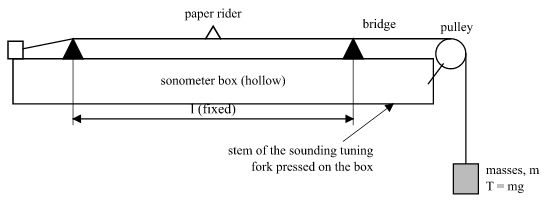
Theory: for a stretched wire f=2l1μT, so for a fixed length l and the same wire, f2∝TFix the bridges so that the vibrating length l is constantStrike a tuning fork of known frequency f1 and press its stem on the sonometer boxPlace a light paper rider at the middle of the wireAdjust the masses on the hanger until the paper rider is thrown off (resonance); record the tension T1=mgRepeat with tuning forks of other known frequencies f2,f3,… and record the tensionsPlot a graph of f2 against TA straight line through the origin shows f2∝T, i.e. the fundamental frequency is proportional to the square root of the tension(c)(i)(4 marks)Water closes the lower end, so the air column is a closed pipe; the depth of the water level from the top is the air-column lengthl1+e=4λ,l2+e=43λl2−l1=2λ96.3−31.5=64.8cm=2λλ=129.6cm=1.296mv=fλ=264×1.296=342m s−1(c)(ii)(2 marks)e=4λ−l1=4129.6−31.5e=32.4−31.5=0.9cm(d)(i)(1 mark)Beats are the periodic rise and fall in loudness heard when two notes of slightly different frequencies are sounded together(d)(ii)(5 marks)Sound the note of unknown frequency f together with a standard tuning fork of known frequency fs close to itCount the number of beats n heard in a time t measured with a stop-watchBeat frequency b=tn, so f=fs+b or f=fs−bTo decide, load a prong of the standard fork with a little plasticine (wax); this lowers fsSound them together again and count the beatsIf the beat frequency increases, f is above fs: f=fs+bIf the beat frequency decreases, f is below fs: f=fs−bAnswer: (c) v ≈ 342 m/s, end correction 0.9 cmTip: The difference of two successive resonance lengths is λ/2, so the end correction cancels out