What we are solvingRefraction of waves, Huygens' proof of
n=c/v, interference and Young's experiment, and the diffraction grating
Given for (d): 500 lines per mm,
λ=589 nm, normal incidence
Chapter: Wave optics
Topic: Refraction, interference and diffraction of light
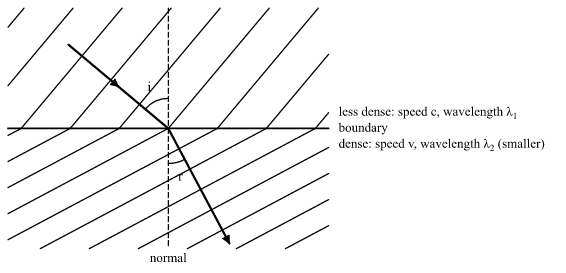
(a) (3 marks)The waves slow down when they enter the denser medium
The frequency stays the same (it is fixed by the source), so the wavelength decreases (
v=fλ): the wavefronts get closer together
If the waves meet the boundary obliquely, one end of each wavefront slows first, so the direction changes and the ray bends towards the normal
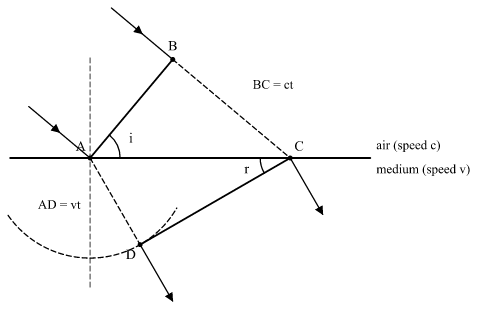
(b) (5 marks)AB is a plane wavefront in air meeting the boundary at A, at angle of incidence
iIn the time
t that the end B takes to reach C in air,
BC=ctSecondary wavelets from A spread into the medium a distance
AD=vtThe tangent CD from C to the wavelet is the refracted wavefront, and the refracted ray AD is perpendicular to it, at angle of refraction
rIn triangle ABC:
sini=ACBC=ACctIn triangle ADC:
sinr=ACAD=ACvtn=sinrsini=vtct=vc(c)(i) (3 marks)Light from two coherent sources (same frequency, constant phase difference) overlaps
By the principle of superposition the resultant displacement is the sum of the separate displacements
Where the path difference is
nλ, the waves meet in phase: constructive interference gives a bright fringe
Where the path difference is
(n+21)λ, they meet in antiphase: destructive interference gives a dark fringe
So alternate bright and dark fringes are formed
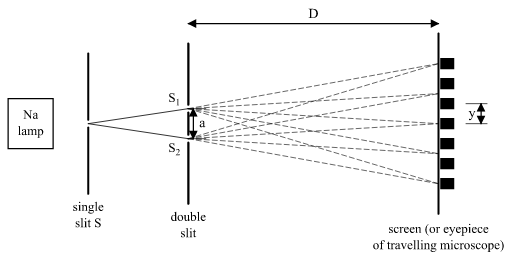
(c)(ii) (5 marks)Light from a monochromatic source (sodium lamp) passes through a narrow single slit S, then falls on two close parallel slits
S1 and
S2S1 and
S2 act as coherent sources; fringes are seen on a screen or through the eyepiece of a travelling microscope at a distance
DMeasure the distance across several (say 10) fringes with the travelling microscope and divide to get the fringe width
yMeasure the slit separation
a with the travelling microscope and
D with a metre rule
λ=Day(d) (4 marks)d=5001 mm=2.0×10⁻⁶ mdsinθ=nλ,sinθ≤1 ⇒ n≤λdλd=589×10−92.0×10−6=3.4Highest order
n=3Images: the zero order plus orders 1, 2 and 3 on each side
N=2×3+1=7Answer: (b) n = c/v; (d) 7 diffraction images (highest order 3)
Tip: Always round d/λ down, and count both sides plus the central image