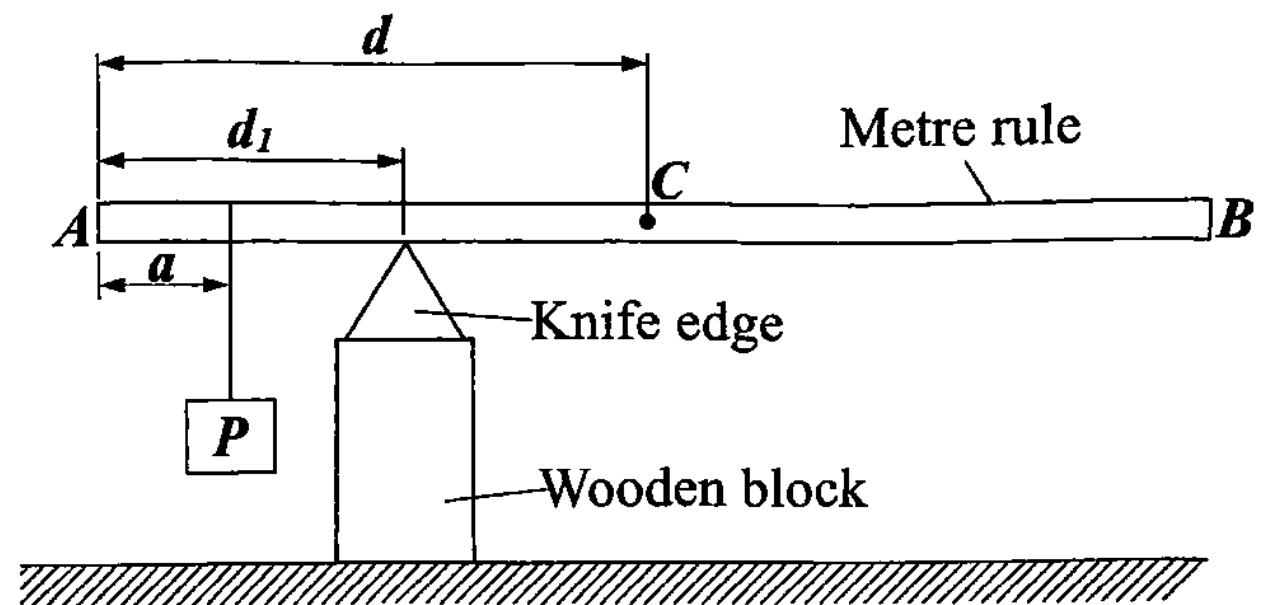
What we are solvingA metre rule balances on a knife edge; a pendulum bob hangs from it
Part I: use a known mass
P=0.050 kg to find the constant
m (the mass of the metre rule)
Part II: balance the rule with the bob in air for six values of
z; a graph of
y1 against
x1 gives
m0 (mass of the bob)
Then
α1=πd36m0 (mass ÷ volume of the sphere)
Part III: balance again with the bob in water; this gives
m0′, then
∅,
α2 and the mean
αChapter: Mechanics (statics) and fluids
Topic: principle of moments; Archimedes' principle, density and relative density
Concept and formulasPrinciple of moments: for a body in equilibrium, sum of clockwise moments = sum of anticlockwise moments about any point
The weight of a uniform metre rule acts at its balance point C (centre of gravity)
Part I (moments about the knife edge at
d1):
Pg(d1−a)=mg(d−d1) ⇒ m=(d−d1)0.05(d1−a)m = mass of the metre rule (kg);
d,
d1,
a in the same unit (cm)
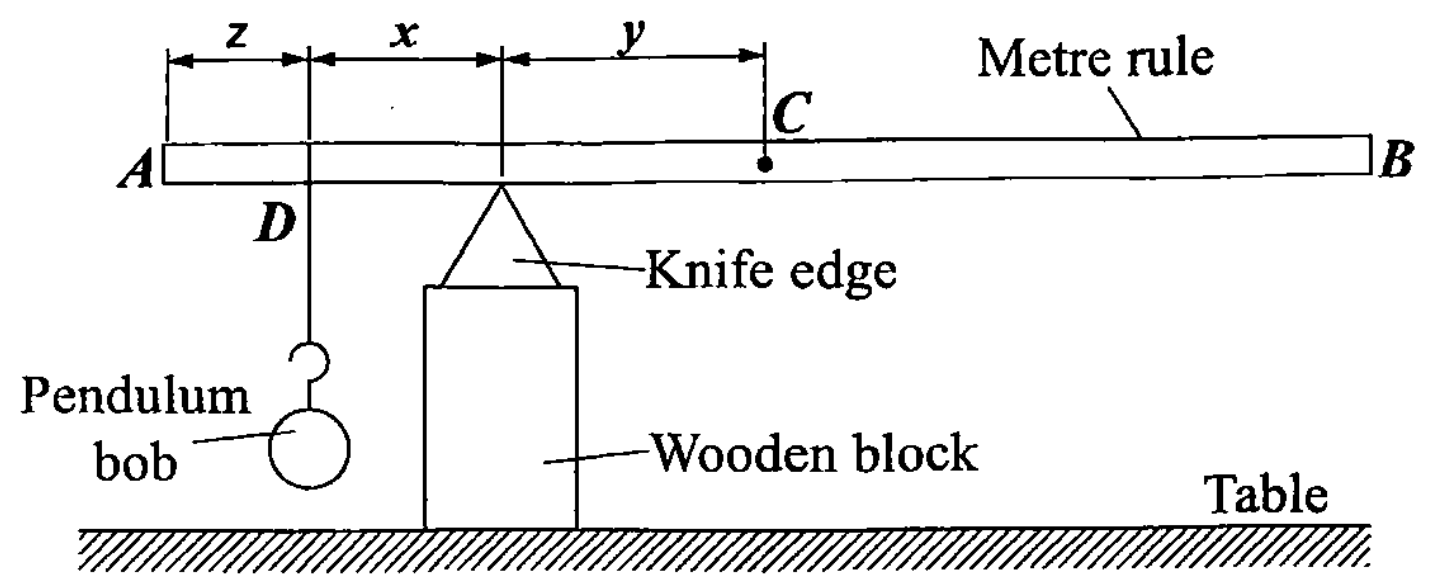
Part II (bob at D, distance
x from the knife edge; rule's weight at C, distance
y):
m0gx=mgy ⇒ y1=m0m⋅x1So
y1 against
x1 is a straight line through the origin with slope
S=m0m, hence
m0=SmVolume of a sphere of diameter
d:
V=6πd3, so
α1=πd36m0=Vm0 = density of the bob (
kg m−3)
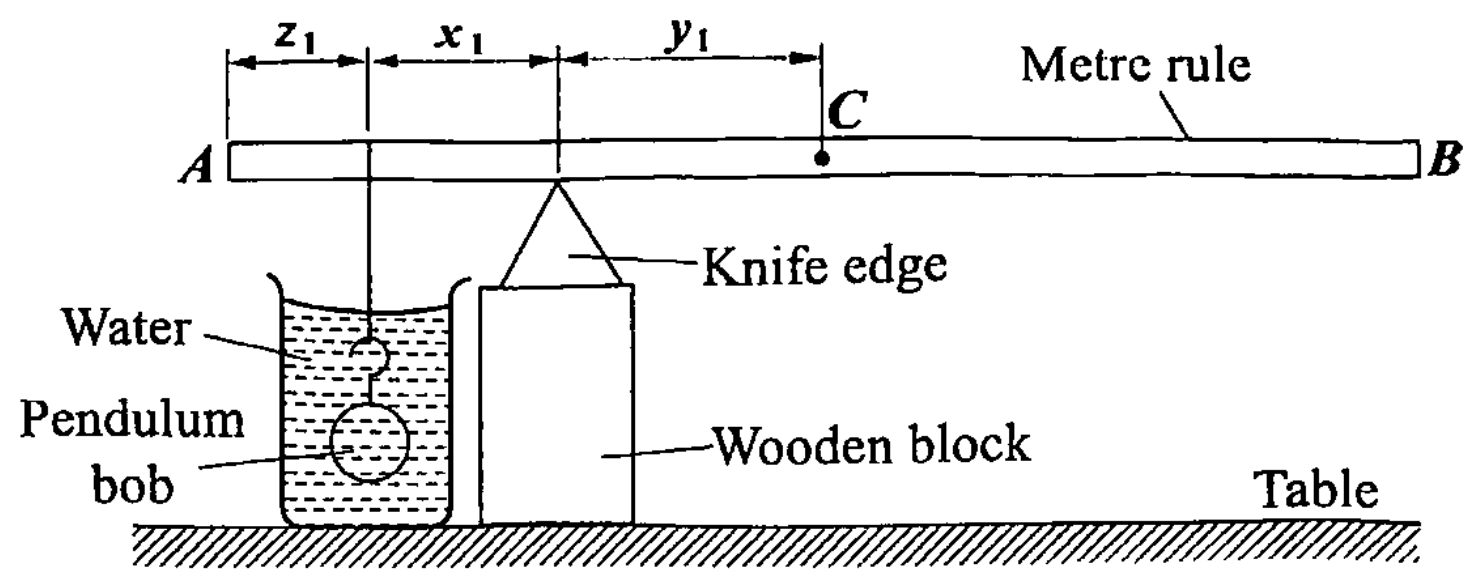
Part III (bob wholly in water): upthrust = weight of water displaced (Archimedes)
The bob acts like a smaller mass
m0′=m0−ρwV, with
ρw=1.0×10³ kg m−3m0′gx=mgy ⇒ m0′=mxyThe paper's formula is the mean of the two balances:
m0′=m(2x1x2x1y2+x2y1)=2m(x1y1+x2y2)∅=m0−m0′m0=mass of equal volume of watermass of bob=relative densityα2=1.0×10³∅ = density of the bob again, by a second method;
α = mean of the two
Part I (a), (b)1. Place the metre rule, graduated face up, on the knife edge; slide it until it rests horizontally
2. Read the balance point C on the scale:
d = distance of C from end A
Sample readings (your own readings will differ):
d=50.0 cmPart I (c), (d), (e)3. Hang the
0.050 kg mass by a thread loop at
a=10.0 cm from A
4. Move the knife edge until the rule again balances horizontally (Fig. 1.1)
5. Read the knife-edge position:
d1 from A
d1=38.2 cmPart I (f)m=(50.0−38.2)0.05(38.2−10.0)=11.80.05×28.2=11.81.41m=0.119 kgPart II (a)Measure the diameter of the bob with vernier callipers in two perpendicular directions, take the mean; check the zero error
d=2.50 cm=0.0250 mPart II (b) to (e): procedure1. Hang the bob by its thread at D,
z=5.0 cm from A (the thread loop must sit exactly on the mark)
2. Move the knife edge until the rule balances horizontally (Fig. 1.2)
3. Read the knife-edge position; then
x = knife edge −
z and
y=d − knife edge (C stays at
50.0 cm)
4. Repeat for
z=10.0,15.0,20.0,25.0 and
30.0 cmPart II (f): table of resultsSample readings (your own readings will differ):
| z (cm) | x (cm) | y (cm) | x1 (×10−2 cm−1) | y1 (×10−2 cm−1) |
|---|
| 5.0 | 29.0 | 16.0 | 3.45 | 6.25 |
| 10.0 | 25.8 | 14.2 | 3.88 | 7.04 |
| 15.0 | 22.6 | 12.4 | 4.42 | 8.06 |
| 20.0 | 19.3 | 10.7 | 5.18 | 9.35 |
| 25.0 | 16.1 | 8.9 | 6.21 | 11.24 |
| 30.0 | 12.9 | 7.1 | 7.75 | 14.08 |
Check:
x+y=50.0−z in every row
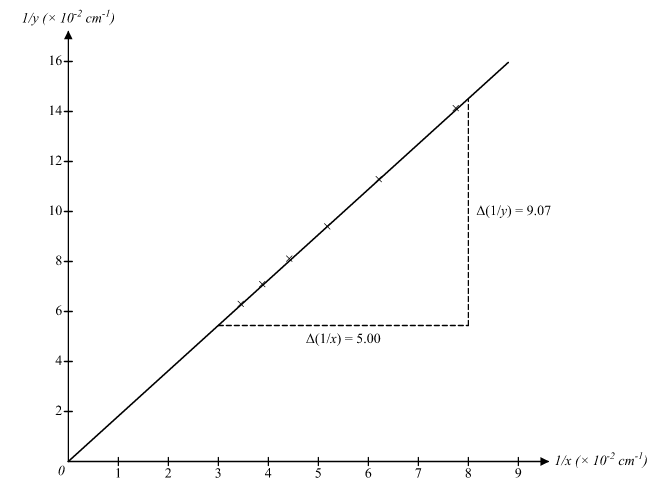
Part II (g): graphPlot
y1 (vertical) against
x1 (horizontal); draw the best straight line (it passes through, or very near, the origin)
Part II (h): slopeUse two points on the line far apart (not table points):
(3.00,5.44) and
(8.00,14.51), both in
10−2 cm−1S=8.00−3.0014.51−5.44=5.009.07=1.81(
S has no unit: both axes are in
cm−1)
Part II (i)m0=Sm=1.810.119=0.0657 kgPart II (j)Use
d in metres:
d3=(0.0250)3=1.5625×10⁻⁵ m3α1=π×1.5625×10−56×0.0657=4.909×10−50.3942α1=8.03×10³ kg m−3Part III (a) to (d): procedure1. Hang the bob at
z1=10.0 cm from A; raise a beaker of water under it so the bob is wholly immersed and touches neither the sides nor the bottom
2. Move the knife edge until the rule balances horizontally (Fig. 1.3); record
x1 and
y13. Repeat with the bob at
z2=15.0 cm; record
x2 and
y2Sample readings (your own readings will differ):
x1=27.0 cm,y1=13.0 cmx2=23.6 cm,y2=11.4 cm(Compared with air,
y is smaller for the same
z: the upthrust makes the bob act lighter)
Part III (e)x1y2=27.0×11.4=307.8,x2y1=23.6×13.0=306.82x1x2=2×27.0×23.6=1274.4m0′=0.119×1274.4307.8+306.8=0.119×0.4823m0′=0.0574 kgPart III (f)∅=0.0657−0.05740.0657=0.00830.0657=7.92(
∅ is the relative density of the bob, no unit)
Part III (g)α2=1.0×103×7.92=7.92×10³ kg m−3Part III (h)α=21(8.03×10³+7.92×10³)α=7.98×10³ kg m−3α is the density of the material of the bob (close to that of steel or iron, about
7.9×10³ kg m−3)
Part III (i): sources of error (any three)1. The knife edge has a finite width, so the pivot point (and
x,
y) is not read exactly
2. Parallax when reading the scale at the thread and at the knife edge
3. The rule may not be exactly horizontal at balance; draughts disturb the balance
4. The bob not wholly immersed, touching the beaker, or with air bubbles on it; the wet thread adds a little mass
5. The bob is not a perfect sphere (it has a hook), so
V=6πd3 is only approximate; zero error of the callipers
6.
m0−m0′ is a small difference of two close numbers, so a small error in
y1 or
y2 gives a large error in
∅Answer: (sample values)
m=0.119 kg,
S=1.81,
m0=0.0657 kg,
α1=8.03×10³ kg m−3m0′=0.0574 kg,
∅=7.92,
α2=7.92×10³ kg m−3,
α=7.98×10³ kg m−3 (density of the bob)
Tip: Keep
x and
y in the same unit (cm) in the ratios, but put
d in metres before cubing it