What we are solvingThe constant
ρo of dry cell C is its internal resistance
rPart I: the cell drives current through lengths of wire Q; voltmeter and ammeter give
r twice (
ro,
r1), mean
r2Part II: a potentiometer compares the e.m.f. of C with its terminal p.d. when C is shunted by a length
y of wire W; a graph gives
r3Then
ρo=21(r2+r3)Chapter: Current electricity
Topic: e.m.f. and internal resistance; the potentiometer
Concept and formulasA cell of e.m.f.
E and internal resistance
r driving a current
I has terminal p.d.
V=E−Irr=IE−VWith switch K open the voltmeter (high resistance, almost no current) reads the e.m.f.
EPotentiometer: at balance no current flows in the galvanometer, so the p.d. balanced is proportional to the balance length
K
2 open: C gives no current, so
E∝Zo; K
2 closed: C drives current through the length
y of wire W, so its terminal p.d.
V∝ZZZo=VE=RR+r=1+RrResistance of length
y of a wire of diameter
d and resistivity
ρ:
R=Aρy=πd24ρyZZo=1+(4ρπd2r)y1So
ZZo against
y1 is a straight line of intercept 1 and slope
S=4ρπd2r, giving
r3=πd24ρS(
S in m,
d in m,
ρ=4.7×10⁻⁷ Ωm, so
r3 in
Ω)
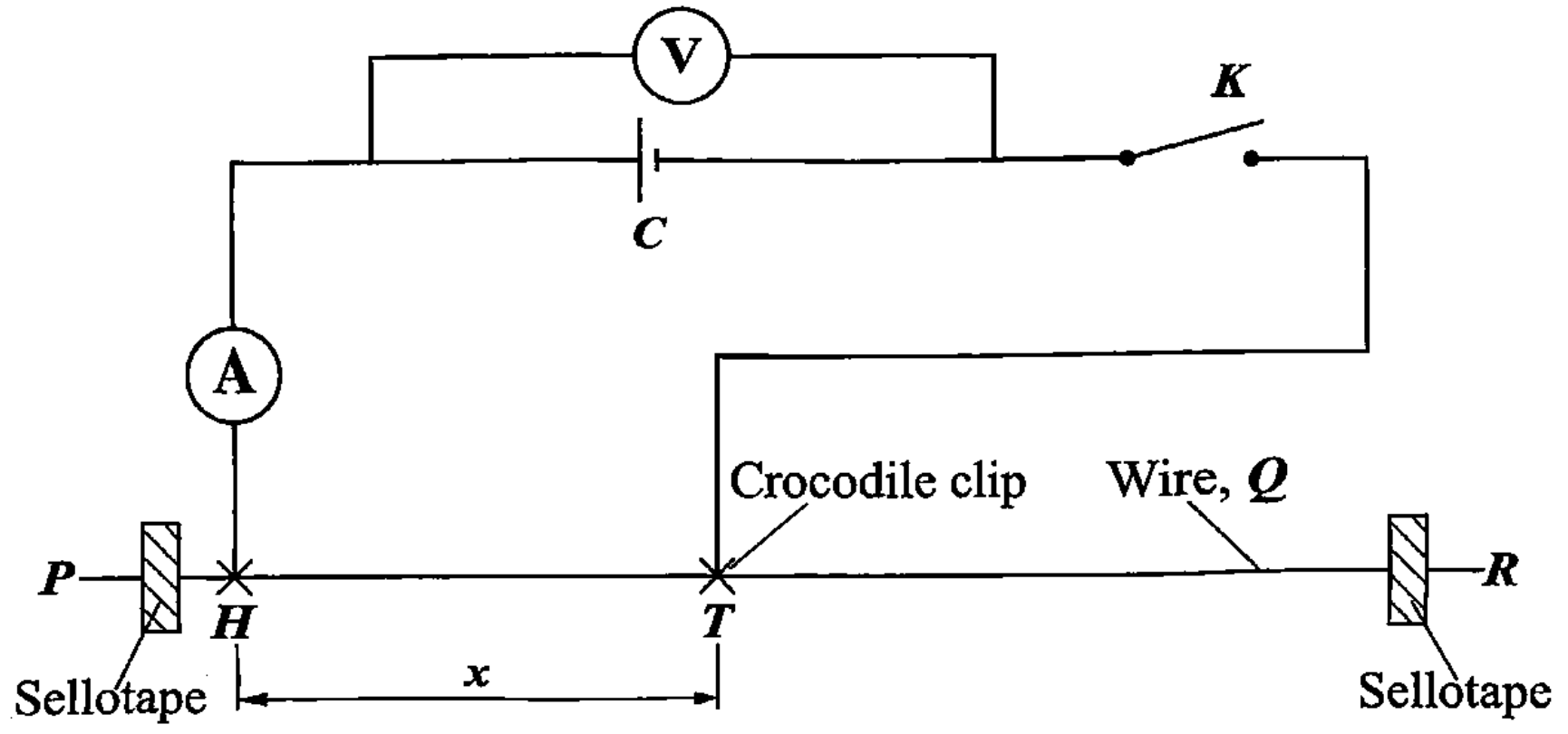
Part I (a) to (e)1. Connect the circuit of Fig. 3.1: cell C, ammeter, key K and wire Q from H to the crocodile clip T; voltmeter across C
2. With K open, read the voltmeter: this is
E3. Close K; set the clip so that
HT=x=0.300 m; read the ammeter and voltmeter
Sample readings (your own readings will differ):
E=1.50 V,Io=0.54 A,Vo=1.07 VPart I (f)ro=0.541.50−1.07=0.540.43=0.796 ΩPart I (g) to (k)Open K (so the cell does not run down), set
x=0.700 m, close K, read the meters, open K
I1=0.28 A,V1=1.28 V(Longer wire, larger resistance: less current and a larger terminal p.d.)
Part I (l)r1=0.281.50−1.28=0.280.22=0.786 ΩPart I (m), (n)r2=21(0.796+0.786)=0.791 ΩThen disconnect the circuit
Part II (a)Measure the diameter of the wire with a micrometer screw gauge at several places along it, take the mean; correct for zero error
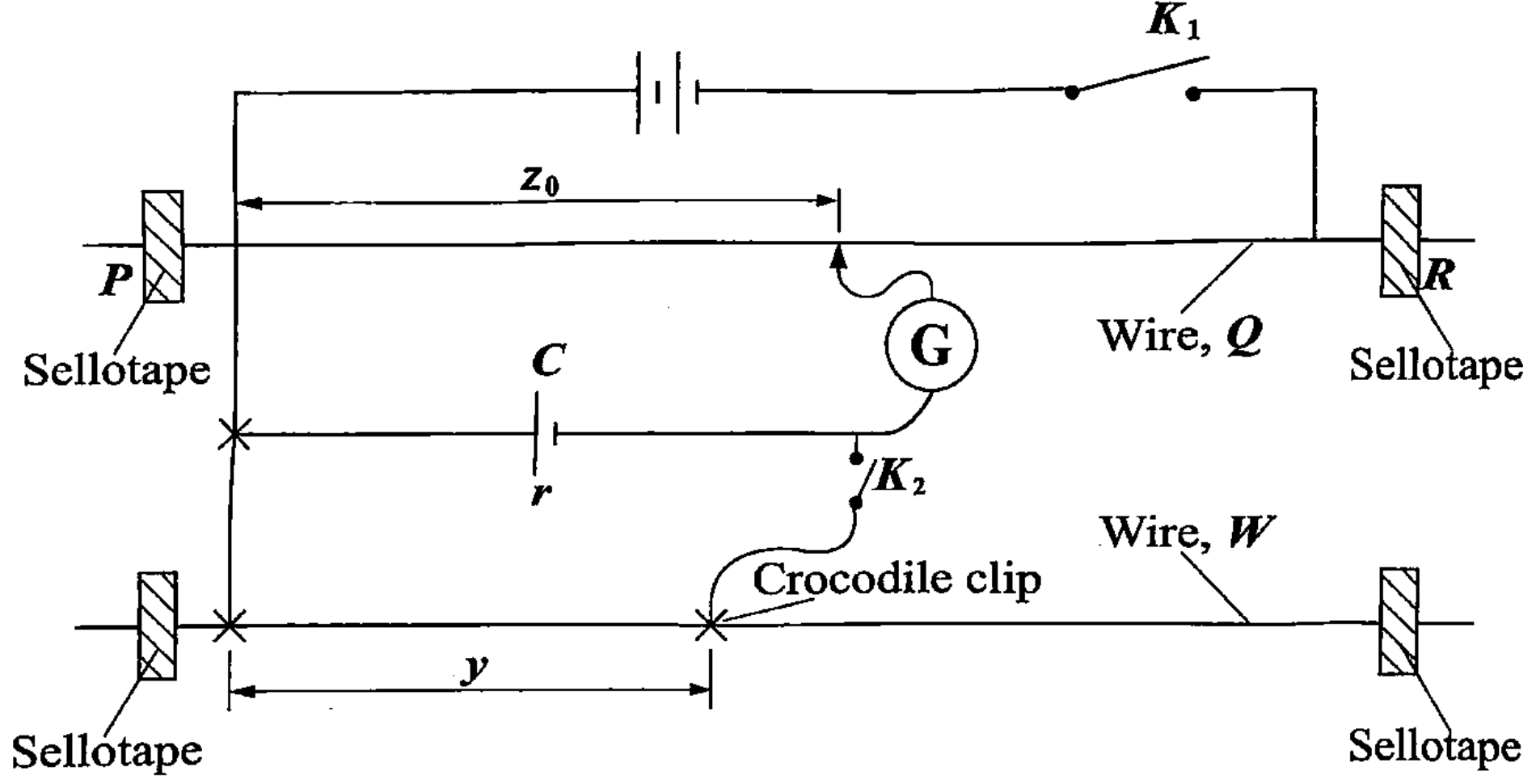
d=0.30 mm=3.0×10⁻⁴ mPart II (b) to (i): procedure1. Connect Fig. 3.2: the driver cells and K
1 across wire Q (PR); cell C (same polarity side as the driver at P) in series with G to a jockey on PR; wire W connected across C through K
2 and the crocodile clip
2. K
2 open, K
1 closed: tap the jockey along PR until G shows no deflection; read the balance length
Zo from P
3. Close K
2; set the clip so that
y=0.100 m; find the new balance length
Z4. Open K
1 and K
2 between readings; repeat for
y=0.150,0.200,0.250,0.300,0.350 and
0.400 mSample readings (your own readings will differ):
Zo=0.750 mPart II (j): table of results| y (m) | y1 (m−1) | Z (m) | ZZo |
|---|
| 0.100 | 10.00 | 0.340 | 2.206 |
| 0.150 | 6.67 | 0.416 | 1.803 |
| 0.200 | 5.00 | 0.468 | 1.603 |
| 0.250 | 4.00 | 0.506 | 1.482 |
| 0.300 | 3.33 | 0.535 | 1.402 |
| 0.350 | 2.86 | 0.558 | 1.344 |
| 0.400 | 2.50 | 0.577 | 1.300 |
(
Z gets larger as
y grows: a longer shunt takes less current, so the terminal p.d. is closer to
E)
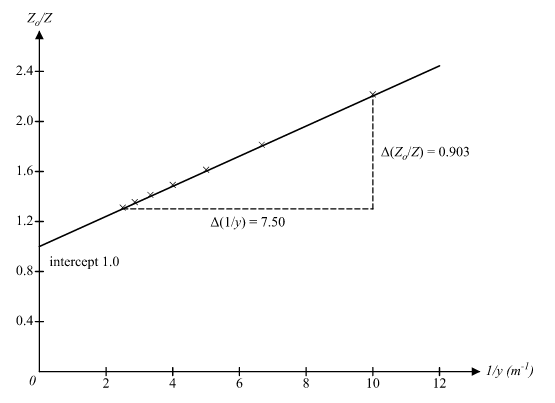
Part II (k): graphPlot
ZZo (vertical) against
y1 (horizontal) and draw the best straight line; it cuts the vertical axis near 1
Part II (l): slopeTwo points on the line:
(2.50,1.301) and
(10.00,2.204)S=10.00−2.502.204−1.301=7.50 m−10.903=0.120 mPart II (m)πd2=π×(3.0×10⁻⁴)2=2.827×10⁻⁷ m2r3=2.827×10−74×4.7×10−7×0.1204=2.827×10−72.264×10−7r3=0.801 ΩPart II (n)ρo=21(r2+r3)=21(0.791+0.801)=0.796 Ωρo≈0.80 Ω is the internal resistance of the dry cell C
Part II (o): sources of error1. The cell polarises and its e.m.f. falls while it gives current (keep switches closed only while reading)
2. Contact resistance at the crocodile clips and terminals; the wire is not perfectly uniform
3. The wire heats up and its resistance changes when current flows for long
4. The voltmeter draws a small current, so the reading
E is a little below the true e.m.f.; zero errors of the meters
5. Difficulty in finding the exact null point; parallax in reading lengths; zero error of the micrometer (
d is squared, so its error doubles)
Answer: (sample values)
E=1.50 V,
ro=0.796 Ω,
r1=0.786 Ω,
r2=0.791 ΩS=0.120 m,
r3=0.801 Ω,
ρo=0.80 Ω (internal resistance of cell C)
Tip: If the jockey finds no balance point on PR, check that the positive terminals of the driver cells and of cell C both go to end P