Test Index
UACE Physics 2026 Paper 1 (Theory)
Show Para
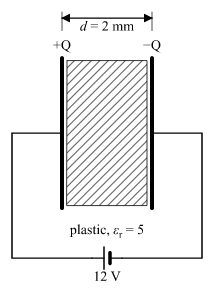
Question Numbers: 10-12Item 5Petrol engines run on a mixture of compressed petrol vapour and air, which gets ignited at a spark gap by an electric spark from an induction coil, when starting a car. A mechanic owns a garage and trains recruits on different systems of the car, including the ignition system shown in figure 2.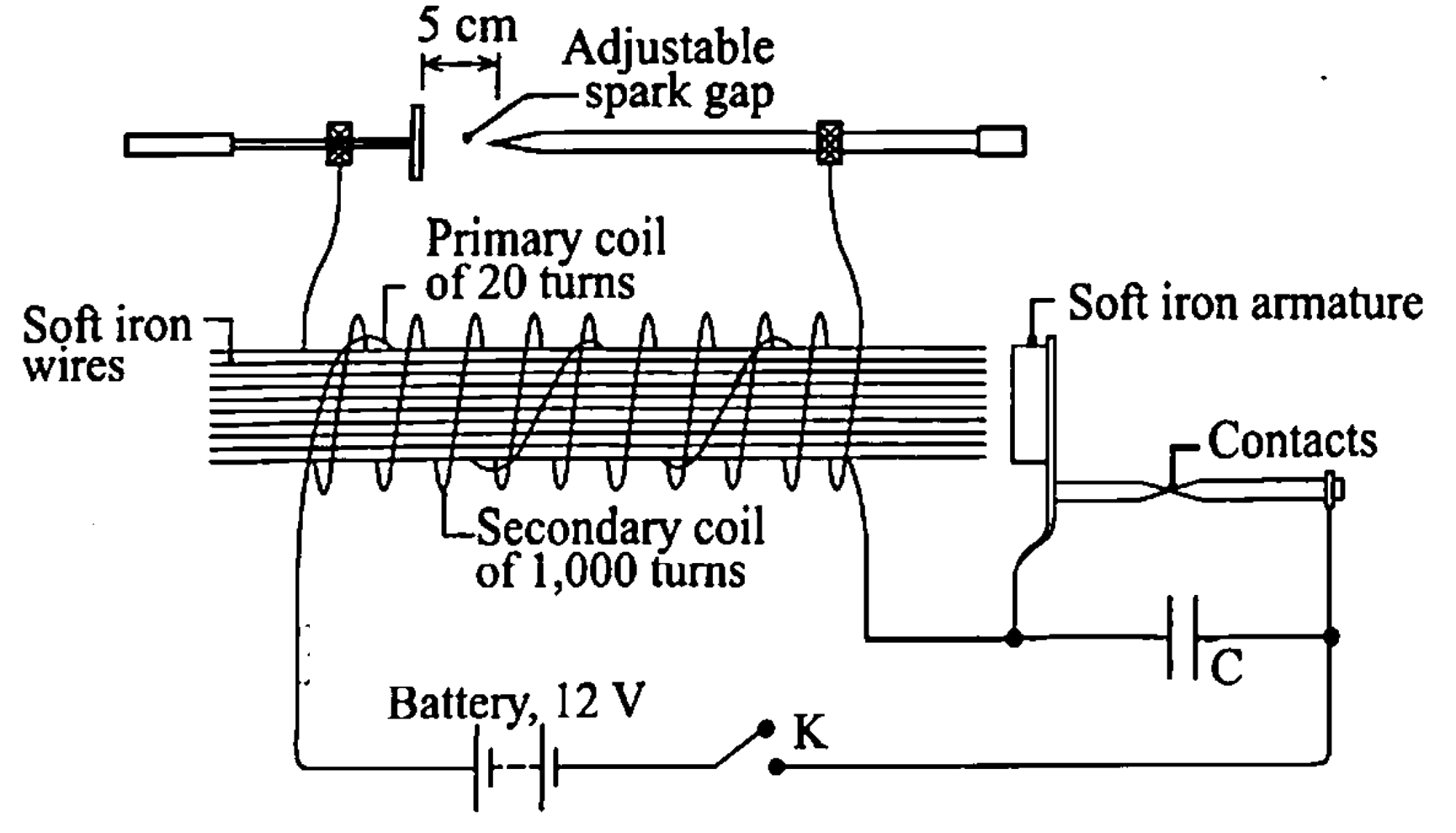 Fig. 2The mechanic often uses the diagram in figure 2 to show the trainees the circuit of the induction coil used in the ignition start-switch of the car.After thorough discussion and analysis of the circuit, the mechanic tasks the trainees to establish whether a battery can produce an electric field intensity at the spark gap, large enough to cause an ignition spark, given that the dielectric field strength for the mixture of petrol vapour and air at the gap is and permittivity of free space, , is .At the garage, there is a system that uses a capacitor to store electric charge. The capacitor used has parallel plates, each of area , placed apart with a plastic material of dielectric constant 5, between the plates and a p.d of across the plates. Available information indicates that for the capacitor to be effective, it should store at least of charge.The mechanic has acquired a new appliance that runs on an a.c voltage of . However, the sockets at the garage have an a.c voltage of and the mechanic has to acquire another device for the appliance to work effectively.
© africaexams.com
Question : 11
Total: 15
Go to Question: