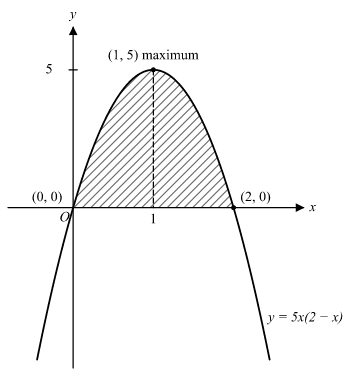
What we are solving(a) Sketch
y=5x(2−x), showing intercepts, the turning point and its nature
(b) The region between the curve and the
x-axis turns once about the
x-axis: find the volume of the solid
Chapter: Curve sketching; Integration
Topic: sketching a quadratic; volume of revolution
Concept and formulasIntercepts: put
y=0 for the
x-axis and
x=0 for the
y-axis
Turning point:
dxdy=0; nature from the sign of
dx2d2yVolume when
y=f(x) from
x=a to
x=b turns about the
x-axis:
V=π∫aby2dx(a) (8 marks)y=5x(2−x)=10x−5x2Intercepts: y=0 gives
x=0 or
x=2: points
(0,0) and
(2,0)x=0 gives
y=0: the curve passes through the origin
Turning point:dxdy=10−10x=0 ⇒ x=1, y=5(1)(1)=5dx2d2y=−10<0So
(1,5) is a maximum point
Behaviour: the
x2 coefficient is negative, so as
x→±∞,
y→−∞ (the curve opens downwards)
The curve is symmetrical about the line
x=1Some values:
x=−1, y=−15;
x=3, y=−15(b) (4 marks)The region (hatched) lies between
x=0 and
x=2V=π∫02(10x−5x2)2dx=π∫02(100x2−100x3+25x4)dx=π[3100x3−25x4+5x5]02=π(3800−400+160)=π(3800−720)=380πV=380π≈83.78 cubic unitsAnswer: (a) curve through
(0,0) and
(2,0) with maximum
(1,5), opening downwards
(b)
V=380π≈83.8 cubic units
Tip: Square
y before integrating:
π∫y2dx, not
π(∫ydx)2