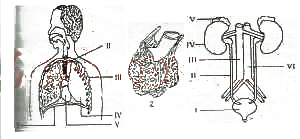
Concept:Nitrogenous waste is removed from the blood by the kidneys and transported as urine, which is then stored in the urinary bladder.
Explanation:The kidney filters blood and forms urine that contains nitrogenous wastes such as
urea.
From the kidney, urine flows through the ureter into the urinary bladder.
The urinary bladder temporarily stores this urine before it is passed out of the body.
Because it stores urine, the bladder holds the largest collected amount of nitrogenous waste.
The other labelled parts either produce urine or simply carry it along, so they do not contain as much nitrogenous waste as the bladder.
Therefore, the labelled part that contains the highest amount of nitrogenous waste is the urinary bladder.
Answer:The part labelled IV, the urinary bladder.