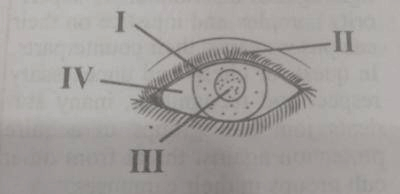
Concept:The diagram is an external view of the human eye. The eye is protected by accessory structures outside the eyeball: the eyebrows, the eyelids and the eyelashes.
Explanation:The labelled parts are: I = iris (the coloured, dotted ring), II = eyelashes, III = pupil (the central opening), IV = sclera (the white of the eye).
The eyelashes (II) form a row of hairs along the edge of the eyelid. They trap dust, sweat and small insects and set off the blink reflex, so they keep foreign particles out of the eye. They are the protective part labelled in the diagram.
The iris (I) controls the size of the pupil, and the pupil (III) lets light into the eye; neither protects the organ.
The sclera (IV) is the white outer coat of the eyeball itself. It keeps the eyeball in shape, but it is part of the organ, not the structure that guards the organ from the outside.
Key point: The stored key gave IV (sclera). The question asks for the part that protects the organ (the eye), and in this external view that is the eyelashes, II.
Answer:Option B (II)