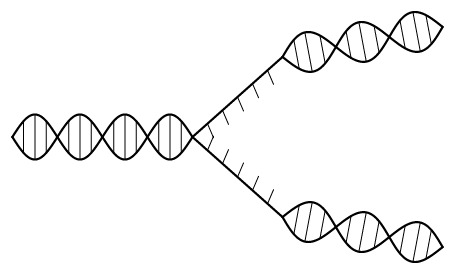
Concept:DNA replication is the copying of a DNA molecule to make two identical DNA molecules before a cell divides.
Explanation:The illustration shows a DNA double helix unwinding and its two strands separating (the 'Y'-shaped fork), with unpaired bases exposed.
Each separated strand acts as a template: new nucleotides pair with it (
A with
T,
G with
C) to build a new complementary strand.
The result is two daughter double helices, each with one old and one new strand (semi-conservative replication).
Protein synthesis takes place on ribosomes using mRNA, a gene mutation is a change in the base sequence, and 'gene coding' is not a process shown by an unzipping DNA molecule.
Answer:Option C (DNA replication)