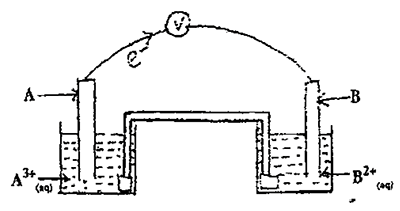
Concept:In an electrochemical cell, oxidation takes place at the anode and reduction (gain of electrons) at the cathode. Electrons flow in the external wire from the anode to the cathode.
Explanation:In the diagram the electrons (
e−) flow through the voltmeter from electrode A to electrode B. So A gives up electrons (anode) and B receives them (cathode).
At the cathode B, the
B2+ ions in the solution take up the electrons arriving through the wire and are deposited as metal B:
B2+(aq)+2e−→B(s)Option A is a reduction of
A3+, which does not happen at A because A is the anode. Options C and D are oxidations (electrons on the right), which belong to an anode; option C is the actual anode reaction.
Answer:Option B (
B2+(aq)+2e−→B(s))