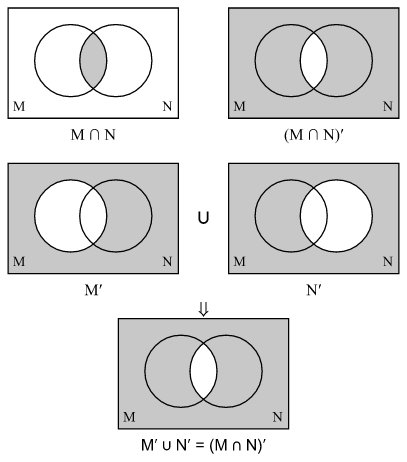
Concept:De Morgan's law shows how the complement of an intersection can be rewritten as the union of complements.
Solution:De Morgan's law states that for any two sets, the complement of their intersection equals the union of their complements.
In symbols, for any sets
A and
B:
(A∩B)′=A′∪B′.
Here, the two given sets are
M and
N, so substitute
A=M and
B=N.
Applying the law gives
(M∩N)′=M′∪N′.
In words, the elements that are not common to both
M and
N are exactly those that are outside
M or outside
N.
Comparing this result with the given options, it directly matches the expression in option D.
Thus, the complement of the intersection of
M and
N simplifies to
M′∪N′.
Answer:Option D (
M′∪N′)