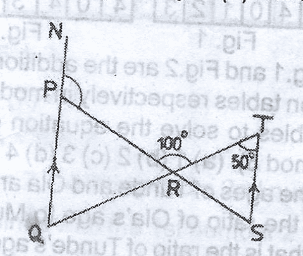
Concept:Use corresponding angles formed by parallel lines and the angle-sum property of a triangle.Explanation:From the diagram, P,R,S lie on the same straight line, so∠TRS=180∘−∠PRT=180∘−100∘=80∘.In △RTS, ∠RTS=50∘.Therefore, ∠TSR=180∘−(80∘+50∘)=50∘.Since NQ∥TS, corresponding angles are equal, so∠QPR=∠TSR=50∘.At point P, PN and PQ lie on the same straight line, hence∠NPR+∠QPR=180∘.Thus, ∠NPR=180∘−50∘=130∘.Answer:∠NPR=130∘ (Option B).