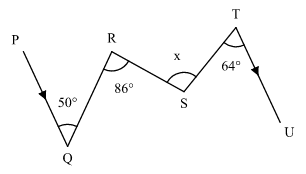
Concept:Draw a line through each bend parallel to
PQ (and so to
TU). Each bend angle then splits into two parts, and each part is an alternate angle of an angle we know.
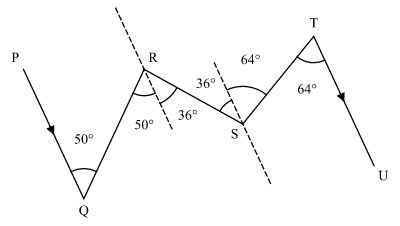
Solution:Draw lines through
R and
S parallel to
PQ (dashed in the figure).
At
R: the part of
∠QRS next to
RQ equals
∠PQR=50∘ (alternate angles), so the other part is
86∘−50∘=36∘.
At
S: the part next to
SR equals that
36∘ (alternate angles), and the part next to
ST equals
∠STU=64∘ (alternate angles, since
TU is parallel to the dashed line).
x=36∘+64∘=100∘Shortcut: In a zigzag between two parallel lines, the angles pointing one way add up to the angles pointing the other way:
50∘+x=86∘+64∘, so
x=100∘. This is just the result of the parallel lines drawn above.
Answer:Option A (
100∘)