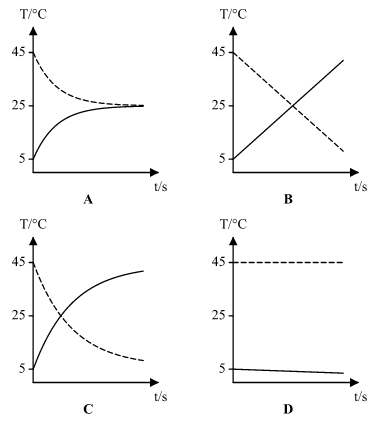
Concept:Heat flows from a hotter body to a colder one until both are at the same temperature (Newton's law of cooling: the rate of change of temperature is proportional to the temperature difference).
Solution:The water at
45∘C (dashed) is hotter than the room, so it loses heat and cools towards
25∘C.
The water at
5∘C (solid) is colder than the room, so it gains heat and warms towards
25∘C.
As each temperature gets closer to
25∘C the difference becomes smaller, so the change becomes slower: both graphs are curves that level off at
25∘C and never cross it.
Graph A shows exactly this.
B: straight lines that pass
25∘C and keep going (the cold water would end hotter than the room).
C: the curves cross and the cold water rises to about
45∘C while the hot water falls towards
5∘C, which is impossible in a room at
25∘C.
D: the temperatures do not move towards
25∘C at all.
Key point: The official key gives (C), but in C the two cups simply swap temperatures, overshooting the room temperature. Neither cup can go past
25∘C, because heat stops flowing once it reaches room temperature.
Answer:Option A (A)