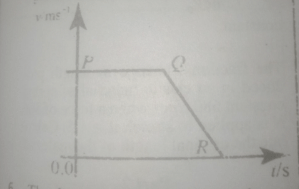
Concept:On a velocity–time graph, the distance travelled by an object is equal to the total area under the graph between the two given times.
Explanation:The motion of the cyclist from P to R is shown on a velocity–time graph.
The section from P to Q is a straight sloping line, so the area under it is a triangle.
The section from Q to R is horizontal, so the area under it is a rectangle.
To find the total distance travelled from P to R, we must add the triangular area under PQ and the rectangular area under QR.
Therefore, the total distance is represented by the whole area under the graph from P to R, which is the area under PQR.
The gradient of a velocity–time graph would give acceleration, not distance, so the other options are incorrect.
Answer:B. area under PQR