Paper question 2
(a) Why the plant was kept in a dark room for two days (1 mark)To destarch the leaves (remove all the starch already in them).
In the dark the plant cannot photosynthesise, so it uses up its stored starch. Any starch found at the end must then have been made during the experiment.
(b) Two reasons for dipping the leaf in boiling water for 5 minutes (2 marks)1. To kill the leaf cells and stop all chemical (enzyme) reactions in them.
2. To soften the leaf and break the cell membranes, so that ethanol and iodine solution can easily get into the cells.
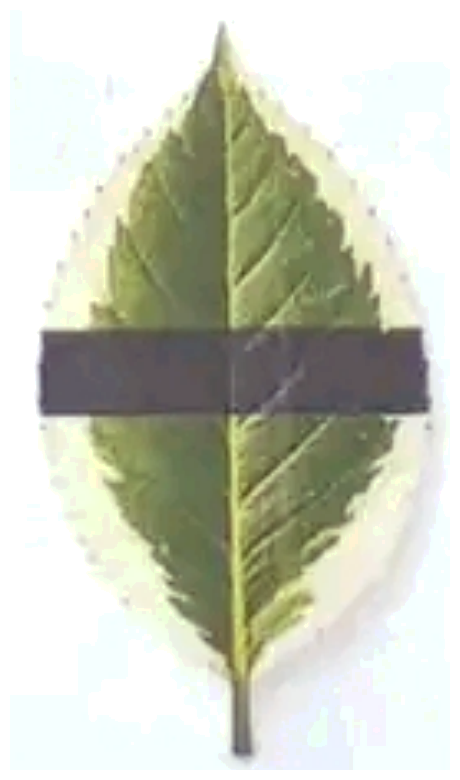
(c) Role of the strip of black paper (2 marks)The black paper stops light from reaching the part of the leaf it covers.
That part cannot photosynthesise, so no starch forms there. Comparing it with the uncovered green part (which got light) shows that
light is necessary for photosynthesis. The covered part acts as a control.
(d) Reason for dipping the leaf in hot ethanol (1 mark)To remove (dissolve) the chlorophyll and decolourise the leaf.
Without the green colour, the colour change with iodine (brown to blue-black) can be seen clearly.
(e) Two conditions investigated (2 marks)Condition I: light (shown by the strip of black paper).
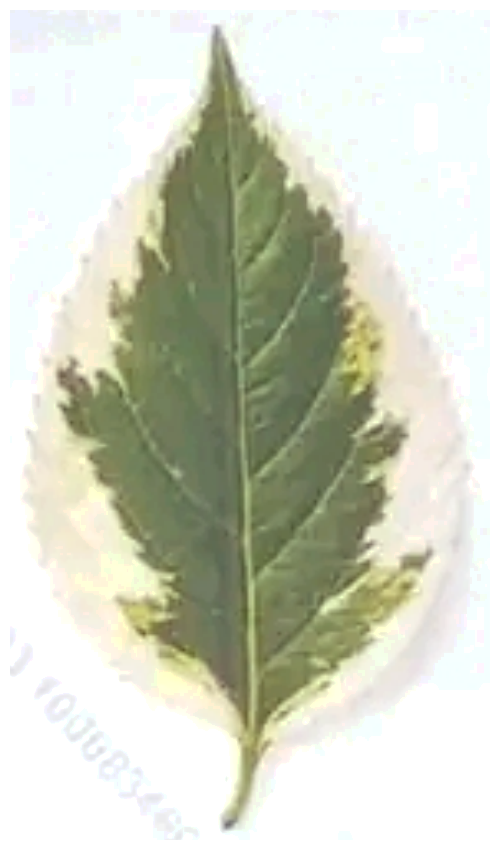
Condition II: chlorophyll (shown by the green and white patches of the leaf).
(f)(i) White patches stayed brown (1 mark)The white patches have no chlorophyll, so no photosynthesis took place there and no starch was made. Iodine stays brown when there is no starch.
(f)(ii) Part covered by the black paper stayed brown (1 mark)No light reached that part, so no photosynthesis took place and no starch was made; iodine solution kept its brown colour.
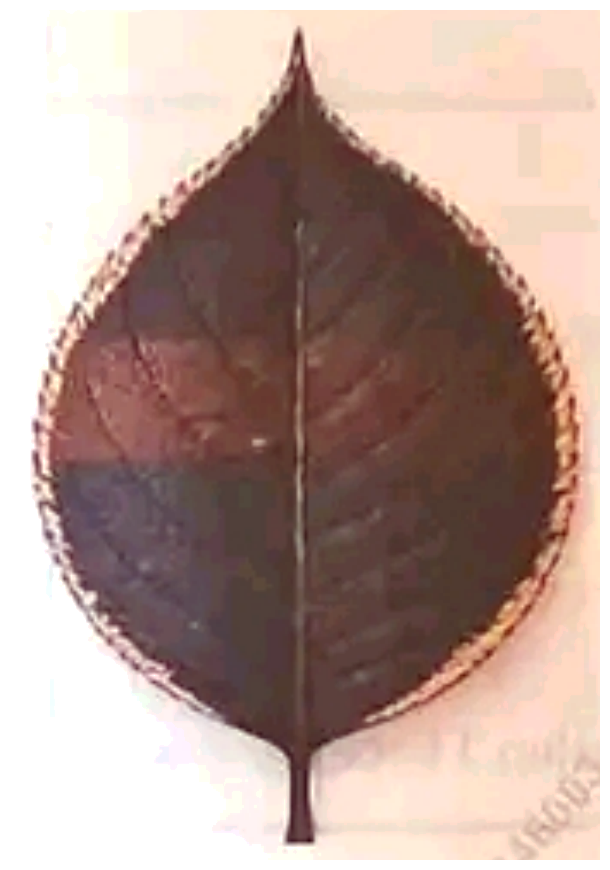
Key point: Iodine solution turns
blue-black only where starch is present. Only the green parts that received light turned blue-black in
Figure 6.