What we are solving(a) Define gene linkage
(b) How codominance shows in the F₁ and F₂ of a monohybrid cross
(c) How linkage changes the F₂ of a dihybrid cross
Chapter: Genetics
Topic: Linkage and codominance
(a) (02 marks)Gene linkage is the occurrence of two or more genes on the same chromosome
so that they tend to be inherited together and do not assort independently at meiosis
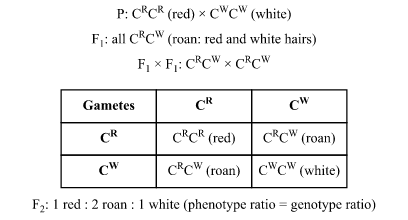
(b)(i) (01 mark)Both alleles are fully expressed in the heterozygote
so all F₁ offspring show a third phenotype in which both parental traits appear together, e.g. roan cattle (red and white hairs)
(b)(ii) (02 marks)Selfing the F₁ gives three phenotypes, not two
Each genotype has its own phenotype, so the phenotype ratio equals the genotype ratio: 1 : 2 : 1 (e.g. 1 red : 2 roan : 1 white)
instead of the 3 : 1 of complete dominance
(c) (05 marks)Without linkage, the F₂ of a dihybrid cross gives four phenotypes in the ratio 9 : 3 : 3 : 1
Linked genes on the same chromosome pass into the same gamete, so the F₁ gives mostly parental gamete types
So the F₂ shows mainly the parental phenotypes, nearer a 3 : 1 ratio (complete linkage)
Recombinant phenotypes are absent, or appear only in small numbers
They arise only by crossing over at prophase I between the linked loci
The farther apart the genes, the more crossing over and the more recombinants; the 9 : 3 : 3 : 1 ratio is not obtained
Answer: (a) genes on one chromosome inherited together; (b)(i) F₁ all intermediate, both traits shown; (b)(ii) F₂ 1 : 2 : 1; (c) mostly parental phenotypes, few recombinants, no 9 : 3 : 3 : 1
Tip: In linkage answers, always mention crossing over as the only source of recombinants.