What we are solving(a) Short day versus long day plants
(b) How flowering is controlled in long day plants, and the effect of a red flash in a long night
(c) Why photoperiod matters for flowering
Chapter: Plant growth and development
Topic: Photoperiodism and phytochrome
(a) (02 marks)Short day plants flower only when the dark period is longer than a critical length (day shorter than critical), e.g. soya bean, tobacco
Long day plants flower only when the dark period is shorter than a critical length (day longer than critical), e.g. wheat, cabbage
(b)(i) (03 marks)Leaves detect day length with the pigment phytochrome
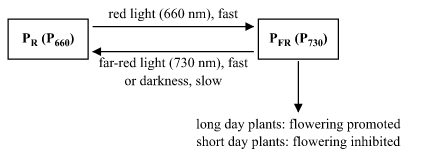
Red light (660 nm) in daylight converts P_R to the active P_FR; in darkness P_FR slowly reverts to P_R
In long days / short nights, much P_FR remains at the end of the night
High P_FR stimulates the leaves to produce the flowering hormone (florigen)
Florigen moves in the phloem to the apical buds, which form flowers
(b)(ii) (02 marks)A red flash converts P_R back to P_FR in the middle of the night
This breaks the long night into two short nights, so P_FR stays high and the long day plant flowers (as if in long days)
(c) (03 marks)It makes all plants of a species in an area flower at the same time, aiding cross-pollination
It times flowering to the season when pollinators are active and conditions suit seed and fruit development
It ensures fruits and seeds mature before unfavourable seasons (dry season or winter)
It keeps flowering of related species apart, reducing cross-breeding
Answer: (a) SDP need nights longer than critical, LDP nights shorter than critical; (b)(i) phytochrome P_FR builds up, florigen made; (b)(ii) red flash restores P_FR, LDP flowers; (c) synchronised flowering, cross-pollination, right season