Test Index
UACE Biology 2022 Paper 2 (Theory)
Solution:
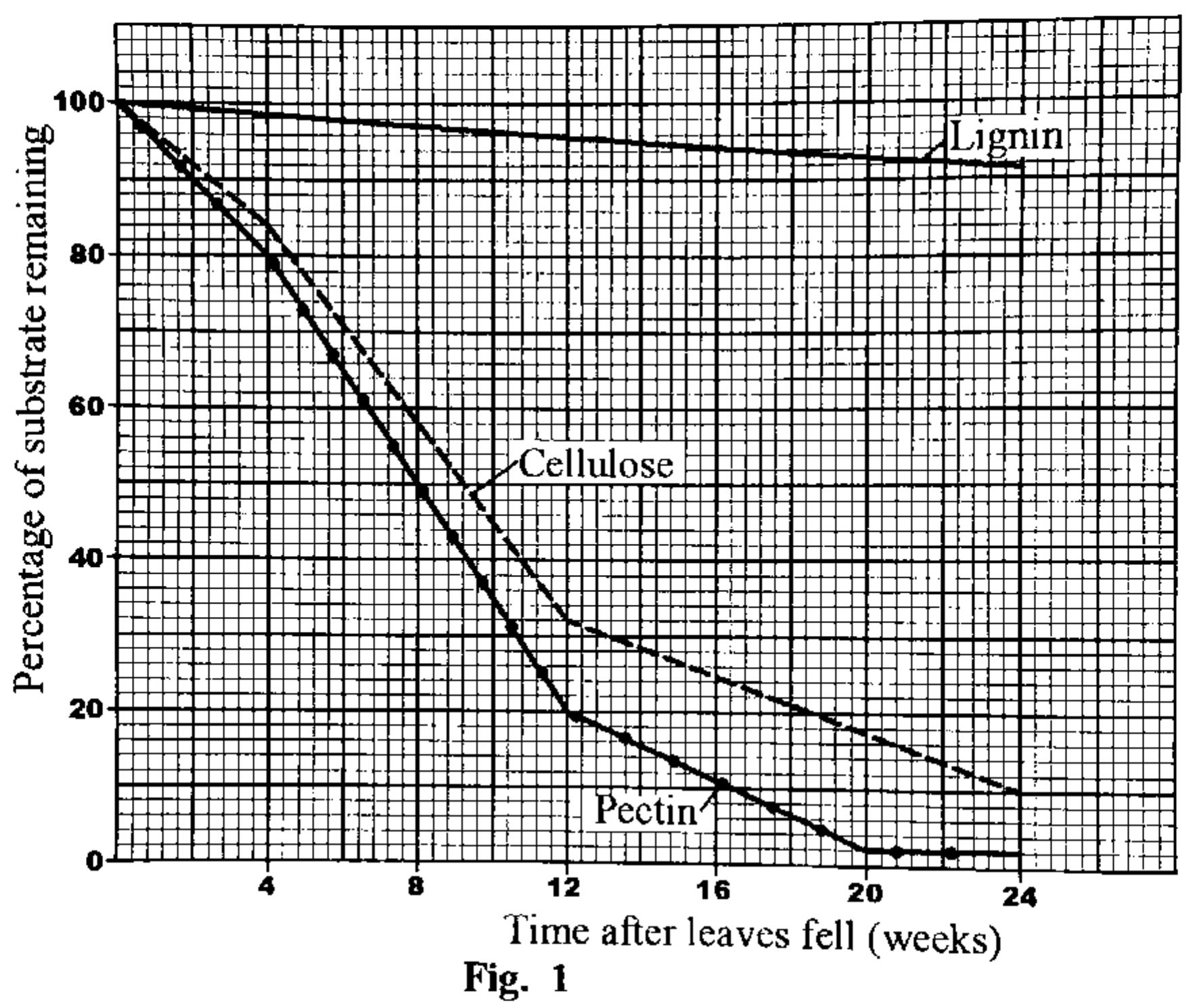
What we are solvingFig. 1 shows the percentage of lignin, cellulose and pectin left in fallen leaves over 24 weeksThe leaves are being broken down by decomposers and detritivoresWe must describe and explain the rate of breakdown of each compound, give the ecological importance of decomposition,explain how fungi break down plant material, and give the importance of lignin to plants and to manChapter: EcologyTopic: decomposition, nutrient cycling; plant cell wall materialsConcept and formulasRate of breakdown = fall in percentage of substrate ÷ time takenrate=time (weeks)change in % remainingA steep downward slope = fast breakdown; a gentle slope = slow breakdown; a flat line = little or no breakdownPectin: soft, amorphous polysaccharide of the middle lamella, easily hydrolysedCellulose: long β-glucose chains packed into crystalline microfibrils in the cell wallLignin: large, cross-linked aromatic (phenolic) polymer that impregnates cell walls; very resistant to enzymesWorking(a)(i) (8 marks)Readings from Fig. 1 (approximate):Pectin:0 to 4 weeks: falls from 100% to about 79%, a fairly rapid rate (about 5% per week)4 to 12 weeks: falls very rapidly from 79% to about 19% (about 7.5% per week), the fastest of the three compounds12 to 20 weeks: falls slowly from 19% to about 1.5% (about 2% per week)20 to 24 weeks: the rate is almost zero; about 1% remains, nearly all pectin is broken downCellulose:0 to 4 weeks: falls gradually from 100% to about 84% (about 4% per week), slower than pectin4 to 12 weeks: falls rapidly from 84% to about 31% (about 6.6% per week)12 to 24 weeks: falls slowly from 31% to about 9% (about 1.8% per week); some cellulose is still left at 24 weeksLignin:0 to 24 weeks: falls very slowly and steadily from 100% to about 92% (about 0.3% per week); most lignin remains after 24 weeksOverall order of rate: pectin > cellulose > lignin(a)(ii) (14 marks)Pectin, initially rapid (0 to 4 weeks):Pectin is a soft, amorphous, hydrophilic polysaccharide in the middle lamella and primary wall, easily reached by enzymesMany bacteria and fungi (the first colonisers of leaf litter) secrete pectinases, so its breakdown starts at oncePectin, very rapid (4 to 12 weeks):Decomposer populations multiply on the leaf, so more pectinase is secretedDetritivores (earthworms, millipedes, termites, woodlice) fragment the leaves, increasing the surface area for enzyme actionBreakdown of the middle lamella separates the cells, exposing more pectinPectin, slow then levelling off (12 to 24 weeks):Little pectin substrate is left, so the rate falls; the small amount remaining is trapped in lignified walls out of reach of enzymesCellulose, slow at first (0 to 4 weeks):Cellulose is crystalline and tightly packed in microfibrils held by hydrogen bonds, so it is hard to hydrolyseIt is covered by pectin and, in places, by lignin and the waxy cuticle, so enzymes reach it only after these are removedFewer organisms produce cellulase, and there is a lag while cellulolytic fungi and bacteria colonise and multiplyCellulose, rapid (4 to 12 weeks):Removal of pectin exposes the cellulose; cellulolytic fungi and bacteria are now numerous and secrete much cellulaseFragmentation by detritivores and softening by moisture increase the area of attackCellulose, slow (12 to 24 weeks):The substrate concentration is low, and the remaining cellulose is bound to lignin in lignified tissues, which protects itShortage of nitrogen in the litter may limit the growth of the decomposersLignin, very slow throughout:Lignin is a large, complex, cross-linked aromatic polymer with many different bonds, so it resists hydrolysisOnly a few organisms (mainly white-rot fungi, basidiomycetes) produce lignin-degrading enzymes (ligninases, peroxidases)Lignin breakdown is oxidative and needs plenty of oxygen; it is slow in wet, poorly aerated litterLignin is insoluble and hydrophobic and gives little energy to the organisms that break it down(b) (5 marks)Decomposition recycles mineral nutrients (nitrogen, phosphorus, potassium, magnesium, sulphur) from dead leaves back to the soil for plant uptakeCarbon in the organic compounds is returned to the atmosphere as carbon dioxide by respiration of decomposers, available for photosynthesis (carbon cycle)Slowly decomposing material, especially lignin, forms humus, which improves soil structure, aeration, water retention and cation exchangeIt provides energy and food for detritivores and decomposers, the start of the detritus food chain, so energy flows on through the ecosystemIt clears dead leaves and prevents accumulation of litter, making space and light available for new growth (seed germination)(c) (5 marks)Fungi are saprotrophs: their branched hyphae spread over and penetrate into the dead plant material, giving a large surface areaThe hyphal tips secrete extracellular hydrolytic enzymes onto the material: pectinases, cellulases, amylases, proteases, and (in some) ligninasesThe enzymes digest the insoluble polymers outside the hyphae into soluble products (sugars such as glucose, amino acids)These soluble products are absorbed through the thin hyphal walls by diffusion and active transport and used in respiration and growthHyphae grow fast and exert pressure at their tips, pushing between cells; fungi tolerate acid litter and produce many spores that spread to new material(d)(i) (5 marks)Lignin is deposited in the walls of xylem vessels, tracheids and sclerenchyma, giving mechanical strength and support, so plants grow tallIt makes the xylem walls rigid so they do not collapse under the tension (negative pressure) of the transpiration streamIt is waterproof, keeping water inside the xylem vessels and reducing lateral leakageIt cements and protects the cellulose fibres, making the walls resistant to attack by fungi, bacteria and herbivoresLignified tissue (wood, bark, seed coats and nut shells) protects internal tissues and seeds from damage(d)(ii) (3 marks)Wood (heavily lignified) is used as timber for building, furniture and tools, because lignin makes it hard and strongWood and charcoal are used as fuel; lignin has a high energy contentLignin in food is dietary fibre (roughage) that aids peristalsis; by-products of the paper industry (lignosulphonates) are used as binders, glues and to make vanillin flavouringAnswer: (a) Pectin is broken down fastest (rapid then levelling off near 1%), cellulose more slowly at first, then rapidly, then slowly (about 9% left), lignin very slowly and steadily (about 92% left)(b) nutrient recycling, carbon cycle, humus formation, detritus food chain, clearing litter(c) hyphae + extracellular enzymes + absorption of soluble products(d) strength, support, waterproofing, protection; timber, fuel, fibreTip: When describing a graph, quote values with units at each turning point (e.g. 79% at week 4) and say whether the rate is fast, slow or constant in each phase
© africaexams.com
Go to Question:
Advertisements