Test Index
UACE Biology 2022 Paper 2 (Theory)
© africaexams.com
Question : 2
Total: 6
Solution:
What we are solving(a) The ways the human body stops or limits the loss of blood after injury(b) How the sodium-potassium pump keeps the water content of a body cell steadyChapter: Transport in animals; cell membranesTopic: haemostasis (blood clotting); active transport and osmoregulation of cellsConcept and formulasHaemostasis = vascular spasm + platelet plug + blood clotting (coagulation)Clotting cascade: prothrombinthrombokinase, Ca2+thrombinfibrinogen (soluble)thrombinfibrin (insoluble)Na⁺/K⁺ pump: a carrier protein (ATPase) that uses one ATP to move 3 Na⁺ out and 2 K⁺ in, against their concentration gradientsWorking(a) (8 marks)Vasoconstriction: smooth muscle in the wall of the damaged vessel contracts (stimulated by serotonin and thromboxane from platelets), narrowing the vessel and reducing blood flowPlatelet plug: platelets stick to exposed collagen fibres of the damaged wall, become sticky, change shape and release ADP and thromboxane, attracting more platelets; they pile up and plug small breaksRelease of thromboplastin (thrombokinase): damaged tissues and platelets release thromboplastin, which starts the clotting cascadeProthrombin to thrombin: thromboplastin, with calcium ions and clotting factors (made in the liver with the help of vitamin K), converts inactive prothrombin into the active enzyme thrombinFibrin formation: thrombin converts soluble fibrinogen into insoluble fibrin threadsClot: the fibrin threads form a mesh that traps red cells and platelets, forming a clot that seals the wound; the clot then contracts (clot retraction), pulling the edges together, and dries into a scabRestoring blood volume: after a large loss, ADH and aldosterone cause the kidneys to retain water and salt, thirst increases intake, and tissue fluid moves into the plasmaReplacement: the bone marrow increases red cell production (stimulated by erythropoietin) and the liver makes more plasma proteins(b) (12 marks)The problem: the cell contains many large organic anions (proteins, nucleic acids, organic phosphates) that cannot leave; they make the cytoplasm hypertonic, so water tends to enter by osmosisNa⁺ also leaks into the cell all the time by diffusion down its concentration gradient, and water follows itAnimal cells have no cell wall, so without control they would swell and burst (lyse)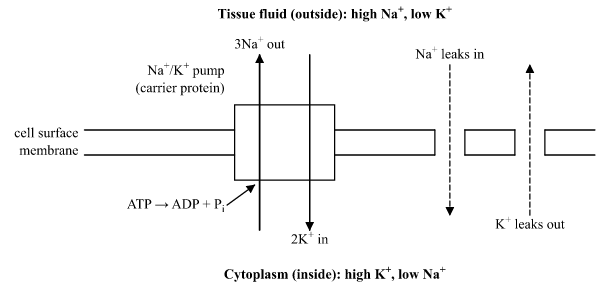 How the pump works:The pump is a carrier protein (Na⁺/K⁺ ATPase) spanning the cell surface membraneThree Na⁺ ions from the cytoplasm bind to sites on the carrier facing the insideATP is hydrolysed to ADP + Pi; the phosphate attaches to the carrier (phosphorylation)The carrier changes shape, opens to the outside and releases the 3 Na⁺ into the tissue fluidTwo K⁺ ions from the tissue fluid now bind to the carrierThe phosphate is released (dephosphorylation); the carrier returns to its first shape and releases the 2 K⁺ inside the cellHow this brings osmotic balance:For every ATP used, 3 positive ions leave but only 2 enter, so there is a net removal of solute particles from the cellThe membrane is much less permeable to Na⁺ than to K⁺, so Na⁺ pumped out stays out; it acts as an impermeant solute outside the cell that balances the large anions insideSo the solute concentration (water potential) of the cytoplasm equals that of the tissue fluid; there is no net entry of water by osmosisThe cell keeps a constant volume and does not burst; if the pump is stopped (by cyanide, cold or ouabain) the cells take in Na⁺ and water and swellThe unequal pumping also keeps the membrane polarised (resting potential), which affects the movement of other ions such as Cl⁻ConclusionBlood loss is stopped by vessel constriction, a platelet plug and a fibrin clot, then volume and cells are replacedThe Na⁺/K⁺ pump uses ATP to expel more cations than it takes in, keeping internal solute concentration equal to the tissue fluid so cell volume stays constantAnswer: (a) vasoconstriction, platelet plug, clotting cascade (thromboplastin, Ca²⁺, prothrombin → thrombin, fibrinogen → fibrin), clot retraction, restoring volume(b) 3 Na⁺ out, 2 K⁺ in per ATP; net loss of solute and Na⁺ kept outside, so no net osmotic entry of waterTip: Always state the numbers 3 Na⁺ out and 2 K⁺ in per ATP and say the carrier changes shape when phosphorylated
© africaexams.com
Go to Question:
Advertisements