Test Index
UACE Biology 2022 Paper 2 (Theory)
© africaexams.com
Question : 3
Total: 6
Solution:
What we are solving(a) How the base sequence of a gene in DNA is copied into mRNA (transcription)(b) How the mRNA code is used to build the polypeptide of an enzyme (translation)Chapter: Genetics; molecular biologyTopic: protein synthesis: transcription and translationConcept and formulasThe genetic code is a triplet code: three bases on mRNA (a codon) code for one amino acidBase pairing in transcription: DNA A pairs with RNA U, T with A, C with G, G with C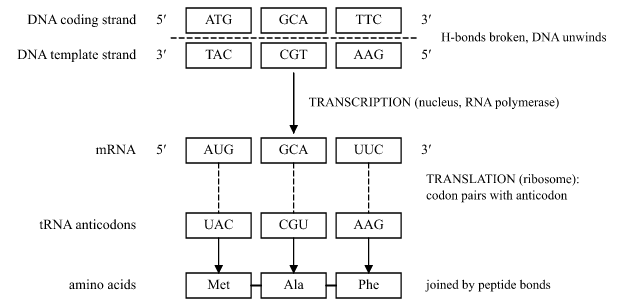 Working(a) (10 marks)Transcription takes place in the nucleusRNA polymerase (helped by transcription factors) binds to the promoter region at the start of the geneThe DNA double helix unwinds locally and the hydrogen bonds between the base pairs break, exposing the bases of the two strandsOnly one strand, the template (antisense) strand, is used; it is read in the 3′ to 5′ directionFree activated ribonucleotides (ATP, UTP, GTP, CTP) in the nucleoplasm pair with the exposed complementary bases: A with U, T with A, C with G, G with CRNA polymerase joins the ribonucleotides by phosphodiester bonds (sugar-phosphate backbone), so the mRNA grows in the 5′ to 3′ directionBehind the enzyme the DNA strands rejoin and rewind into a helixAt a terminator (stop) sequence, RNA polymerase detaches and the pre-mRNA strand is releasedThe pre-mRNA is processed: a cap is added at the 5′ end and a poly-A tail at the 3′ end; introns (non-coding parts) are cut out and exons joined (splicing)The mature mRNA leaves the nucleus through a nuclear pore into the cytoplasm, to the ribosomes(b) (10 marks)Activation of amino acids: in the cytoplasm each amino acid is attached to its own specific tRNA by an enzyme (aminoacyl-tRNA synthetase), using energy from ATPEach tRNA carries an anticodon complementary to an mRNA codon for its amino acidInitiation: the mRNA attaches to the small subunit of a ribosome; the start codon AUG is foundThe tRNA with anticodon UAC carrying methionine pairs with AUG; the large ribosomal subunit then joinsElongation: the ribosome has sites for two tRNAs; a second tRNA with the complementary anticodon brings the next amino acid to the codon beside the firstA peptide bond forms between the two amino acids, catalysed by peptidyl transferase in the ribosomeThe ribosome moves along the mRNA by one codon (translocation); the first tRNA, now free, leaves to collect another amino acidThis is repeated, so amino acids are joined in the order set by the codons, forming a polypeptide; several ribosomes (a polysome) can read one mRNA at onceTermination: at a stop codon (UAA, UAG or UGA) no tRNA fits; the polypeptide is released and the ribosome separatesThe polypeptide coils and folds (in the rough ER and Golgi body) into its specific tertiary (or quaternary) structure, forming the active site of the enzyme; the sequence of amino acids, set by the mRNA, decides this shapeAnswer: (a) RNA polymerase unwinds DNA; template strand read; complementary ribonucleotides (U for A) joined into mRNA; pre-mRNA processed and leaves through nuclear pores(b) tRNA brings amino acids; codon-anticodon pairing on the ribosome; peptide bonds; start AUG, stop codon; polypeptide folds into the enzyme with its active siteTip: Name the enzymes (RNA polymerase, aminoacyl-tRNA synthetase, peptidyl transferase) and the bonds (hydrogen, phosphodiester, peptide): they carry marks
© africaexams.com
Go to Question:
Advertisements