Test Index
UACE Biology 2022 Paper 2 (Theory)
© africaexams.com
Question : 4
Total: 6
Solution:
What we are solving(a) Features of flowering plants that allow them to reproduce on dry land, without water for fertilisation(b) The stages by which the female gametophyte (embryo sac) develops inside the ovuleChapter: Reproduction in plantsTopic: sexual reproduction in flowering plants; megasporogenesis and the embryo sacConcept and formulasOn land the main dangers to reproduction are drying out (desiccation) of gametes and embryos, and the absence of water to carry male gametesFlowering plants solve these with pollen, the pollen tube, enclosed ovules, seeds and fruitsWorking(a) (10 marks)The male gametes are non-motile and are carried to the egg by the pollen tube, so no water is needed for fertilisationPollen grains have a tough outer wall (exine) of sporopollenin that prevents drying out and damage during transferPollen is carried by wind or animals: insect-pollinated flowers have bright petals, scent and nectar; wind-pollinated flowers have light, dry pollen, long filaments and feathery stigmasThe female gametophyte (embryo sac) is retained and protected inside the ovule, which is enclosed in the ovary, and is nourished by the parent plantThe sticky stigma holds the pollen and secretes a sugary fluid that supplies the moisture for pollen germinationDouble fertilisation forms a triploid endosperm, a food store for the developing embryoThe ovule becomes a seed with a tough, waterproof testa, protecting the embryo from drying and damageSeeds can remain dormant through dry or cold seasons and germinate only when conditions are suitableThe ovary becomes a fruit that protects the seeds and helps to disperse them over land (by wind, animals, explosive mechanisms), reducing competitionMany flowers have mechanisms that favour cross-pollination (dichogamy, self-incompatibility) giving variation, but can self-pollinate when cross-pollination fails; many also reproduce vegetatively(b) (10 marks)Inside the nucellus of the ovule, near the micropyle, one cell enlarges to become the megaspore mother cell (diploid, 2n)The megaspore mother cell divides by meiosis to form a linear row (tetrad) of four haploid megasporesThree megaspores (usually those towards the micropyle) degenerate; the one at the chalazal end survives as the functional megasporeThe functional megaspore enlarges, absorbing food from the nucellus, and becomes the embryo sacIts nucleus divides by mitosis to give two nuclei, which move to opposite poles; a large central vacuole forms between themEach nucleus divides by mitosis twice more, giving four nuclei at each pole: eight haploid nuclei in all (three free-nuclear mitoses)One nucleus from each pole moves to the centre; these are the two polar nuclei, which may fuse to form the diploid secondary (definitive) nucleusThe three nuclei at the micropylar end get cell walls and form the egg apparatus: one egg cell (female gamete) and two synergidsThe three nuclei at the chalazal end form the three antipodal cellsThe mature embryo sac therefore has 7 cells and 8 nuclei and is ready for fertilisation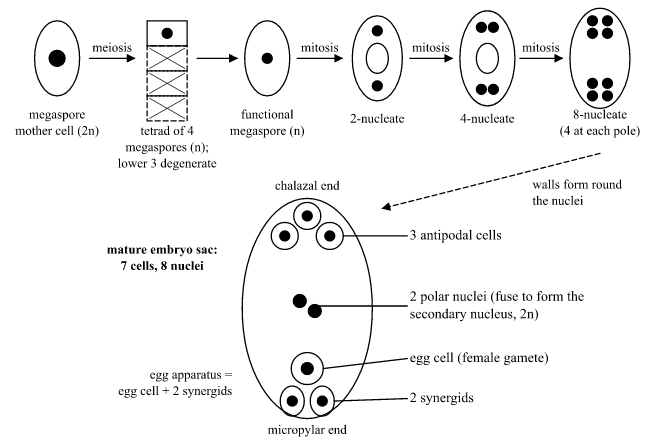 Answer: (a) pollen tube (no water needed), tough pollen, pollination by wind/insects, ovule protected in ovary, endosperm, seed with testa and dormancy, fruits for dispersal(b) megaspore mother cell → meiosis → 4 megaspores (3 degenerate) → functional megaspore → 3 mitoses → 8 nuclei → egg apparatus, 2 polar nuclei, 3 antipodals (7 cells, 8 nuclei)Tip: Say clearly which division is meiosis (only one) and which are mitosis (three); examiners look for this
© africaexams.com
Go to Question:
Advertisements