Test Index
UACE Biology 2022 Paper 2 (Theory)
© africaexams.com
Question : 5
Total: 6
Solution:
What we are solving(a) The structural similarities and differences between cardiac and skeletal muscle(b) How the structure of each type fits it for its job: cardiac muscle pumps blood all life; skeletal muscle moves bonesChapter: Support and locomotion; transport in animalsTopic: muscle tissue structure and functionConcept and formulasBoth are striated muscles made of actin and myosin filaments arranged in sarcomeres; they contract by the sliding filament mechanismCardiac muscle is myogenic and involuntary; skeletal muscle is neurogenic and voluntary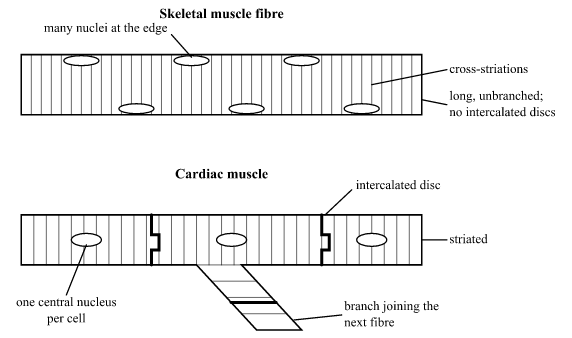 Working(a) (6 marks)Similarities:Both are striated, with myofibrils of actin and myosin arranged in sarcomeres (A and I bands, Z lines)Both have many mitochondria, a sarcoplasmic reticulum, T-tubules and myoglobinDifferences:
(b)(i) (7 marks)It is myogenic: it contracts on its own from impulses of the sinoatrial node, without nerve stimulation, so the heart beats throughout lifeIntercalated discs contain gap junctions that let impulses (ions) pass quickly from cell to cell, so the muscle contracts as one unit (functional syncytium) for an effective beatDesmosomes in the intercalated discs hold the cells firmly together so they are not pulled apart during strong contractionsThe branched, interconnected cells allow the wave of contraction to spread in all directions, squeezing the chambers to expel bloodVery many mitochondria and a rich supply of blood (coronary arteries) and myoglobin give a constant supply of ATP by aerobic respiration, so it does not fatigueIt has a long refractory period, so it cannot be tetanised; it relaxes after each beat, allowing the chambers to refillIts rate can be altered by sympathetic and vagus nerves and adrenaline to match the body's demand(b)(ii) (7 marks)The long fibres are packed with myofibrils of actin and myosin arranged in sarcomeres, giving powerful contraction by sliding of filamentsMuscles are attached to bones by tendons and arranged in antagonistic pairs, so contraction of one moves a bone and the other returns itEach fibre is supplied by a motor neurone at a neuromuscular junction, so contraction is voluntary and quick to startAn extensive sarcoplasmic reticulum stores calcium ions and releases them rapidly when stimulated; T-tubules carry the impulse deep into the fibre so all myofibrils contract togetherContraction can be graded by recruiting more motor units, and sustained by tetanus, for fine control or maximum forceMitochondria, glycogen and creatine phosphate supply ATP; the muscle can also respire anaerobically for short bursts of activityFast-twitch fibres give quick powerful contractions, slow-twitch fibres (rich in myoglobin and mitochondria) give long-lasting contractions for postureAnswer: (a) both striated with sarcomeres; cardiac branched, uninucleate, intercalated discs; skeletal unbranched, multinucleate, no discs(b)(i) myogenic, intercalated discs/gap junctions, many mitochondria, long refractory period(b)(ii) many myofibrils, tendons and antagonistic pairs, motor end plates, sarcoplasmic reticulum, motor unitsTip: In a "compare" question give both similarities and differences, best in a table with matching points side by side
| Cardiac muscle | Skeletal muscle |
|---|---|
| Cells branched, forming a network | Fibres unbranched, long and cylindrical |
| Each cell has one (or two) centrally placed nuclei | Each fibre is multinucleate (syncytium) with nuclei at the edge, under the sarcolemma |
| Cells joined end to end by intercalated discs | No intercalated discs |
| Short cells | Very long fibres |
| Striations less distinct | Striations very distinct |
| More mitochondria; sarcoplasmic reticulum less developed | Fewer mitochondria per unit volume; extensive sarcoplasmic reticulum |
© africaexams.com
Go to Question:
Advertisements